
 English
 中文简体
中文简体 Español
 عربى
عربى
Vent Cap for Automotive Lamps: ePTFE Design, Selection, and Condensation Control
 2026.08.17
 Industry News
Content
- 1 The headlamp fog that points to a bigger problem
- 2 What a vent cap for automotive lamps actually does
- 3 How an ePTFE lamp vent cap works
- 4 Where a vent cap matters most in automotive lighting
- 5 How to select a vent cap for an automotive lamp program
- 6 Quality and manufacturing matter as much as the membrane
- 7 Define the vent requirement before the housing is finalized
The headlamp fog that points to a bigger problem
A driver notices a thin layer of moisture on the inside of a headlamp lens after a rainy night. The lamp still switches on, so the owner treats it as a cosmetic issue. A few months later, the reflector is dull, the connector terminals are corroded, and the LED module begins to flicker. What looked like a small defect was actually a ventilation failure.
The component that prevents this kind of failure is a vent cap for automotive lamps. It allows air and water vapor to move out of the lamp housing while blocking liquid water, dust, road salt, and other contaminants. In short, it lets the lamp breathe under thermal cycles without drawing moisture into the optical cavity.
What a vent cap for automotive lamps actually does
An automotive lamp vent cap is a compact assembly that holds a vent membrane and provides a secure mounting interface to the lamp enclosure. It is usually installed on the rear or lower portion of a headlamp, tail lamp, or fog lamp, where it can exchange air with the atmosphere without collecting water. It performs three tasks at the same time.
Pressure equalization
Lamp housings experience constant temperature changes. When a headlamp is switched on, the air inside expands. When the lamp is switched off, the air contracts. Without a vent, this pressure cycling forces the housing seals to work like a pump, pulling air, moisture, and particles through seams. A vent cap equalizes pressure quickly and reduces the load on the lamp's seals. That is why pressure balance is critical for sealed lighting enclosures, especially when the lamp contains electronic drivers and connector terminals.
Condensation management
Moisture inside a lamp housing can come from water vapor absorbed by plastics, humid air entering through small joints, or temperature changes that drive vapor into the enclosure. When the lens is cold and the housing is warm, the vapor condenses into droplets. Fogging reduces light output and creates hot spots that can damage reflectors, lenses, and circuit boards. By allowing water vapor to leave the housing, the vent cap attacks the root cause of internal fogging rather than just wiping the lens.
Contaminant exclusion
The same vent that releases pressure must prevent water from entering during rain, a pressure washer, or a shallow puddle. A properly designed cap integrates an ePTFE membrane with a hydrophobic surface so that water cannot form a continuous path through the vent. The membrane's pore structure is also small enough to keep dust, fibers, and most airborne contaminants out of the optical cavity.
How an ePTFE lamp vent cap works
The functional core of an automotive lamp vent cap is an ePTFE membrane. Expanded polytetrafluoroethylene is stretched into a microporous structure with millions of tiny pores. These pores are large enough for gas molecules to pass through, but small enough to block liquid water and particulate matter. The membrane itself is hydrophobic, which means water droplets stay on the surface instead of being pulled through the pores. As a material option, the membrane can be supplied as a waterproof permeable vent membrane for automotive lighting.
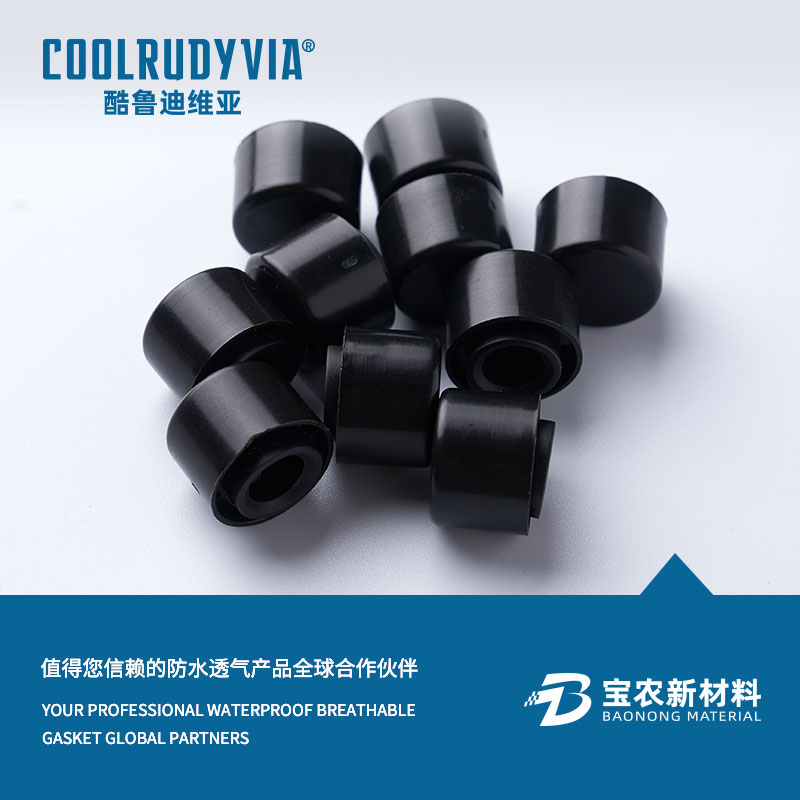 Custom Waterproof Permeable Vent Membrane For Car LightsWe Offer Custom Waterproof Permeable Vent Membrane For Car Lights, Baonong Is China Car Lights Vent Membrane With Adhesive Backing Manufa...View Product →
The cap around the membrane is not decorative. It protects the membrane from mechanical damage, creates a defined path for air to reach the membrane, and provides the threads, barbs, or weld geometry that hold the vent in the lamp housing. The membrane, carrier, and seal have to be matched to each other to create a stable, leak-free vent.
Where a vent cap matters most in automotive lighting
Modern lamp assemblies are compact, visually demanding, and full of heat-sensitive electronics. The vent cap is not an accessory in most designs; it is part of the reliability package.
- Headlamps: LED modules, projectors, and electronic drivers generate strong heat loads and create rapid pressure cycles. Headlamps also face direct impacts from rain, snow, and washer fluid.
- Tail lamps: Thin LED light guides, sealed connectors, and large optical surfaces make tail lamps sensitive to condensation and corrosion. A small vent protects the optical cavity without adding visible hardware.
- Fog lamps and auxiliary lamps: These units are mounted low, close to the road, where they see splash water, salt, gravel, and changes in air pressure. The vent cap must tolerate vibration and maintain its seal under harsh exposure.
Some older designs used a vent hose or a labyrinth channel to relieve pressure. An ePTFE vent cap is simpler to assemble, takes less space, and can be matched to a specific airflow range for a given lamp volume and heat load. For production lamp programs, a well-designed ready-to-install automotive vent cap for lamp assemblies combines the membrane, protective housing, and mounting feature in one validated part.
Custom Vent Cap For Automotive Lamps Manufacturers, FactoryChangzhou Baonong New Material Technology Co., Ltd. Is China Vent Cap For Automotive Lamps Manufacturers, Factory, We Offer Custom Waterp...View Product →How to select a vent cap for an automotive lamp program
The correct vent cap depends on the lamp's internal volume, heat input, mounting location, and expected operating environment. A cap that works on a small tail lamp may be too small for a large headlamp, and a cap tested only in a laboratory may fail when exposed to alkaline wheel cleaning agents. The selection process should begin with the application and then verify the following parameters.
| Parameter | Why it matters | Typical design target |
|---|---|---|
| Airflow rate | Determines how quickly the housing can equalize pressure after a thermal cycle or rapid temperature change. | Often specified in milliliters per minute at a fixed pressure differential, such as 1 to 5 kPa. |
| Water entry pressure | Measures the membrane's resistance to water under pressure. A low value may allow water to pass in a car wash or flood condition. | Common tests target IP68 or IP69K performance when the cap is installed in the housing. |
| Operating temperature | The membrane, adhesive, and cap material must survive short-term heat spikes and cold soak. | A typical range is -40°C to 125°C, depending on lamp location and customer specification. |
| Chemical resistance | Road salt, fuel, washer fluid, and cleaning agents can degrade membranes or housing welds. | Verify the cap against the fluids used in the vehicle and maintenance environment. |
| Mounting and orientation | Press-fit, threaded, and welded caps have different retention forces. The cap must be located where water cannot pool. | The vent should face down or sideways, away from direct spray and splash paths. |
Airflow should not be treated as a generic number. If the cap allows excessive airflow, it may pull dust into the housing; if flow is too low, pressure can still build and create condensation. Membrane area, cap geometry, and the path to the membrane all influence the true flow resistance.
Quality and manufacturing matter as much as the membrane
An automotive vent cap is only as reliable as its weakest interface. A leak around the membrane, a poorly sealed weld, or a damaged pore structure will make even the best ePTFE material ineffective. That is why the supplier's process control is as important as the material data sheet.
Automated assembly equipment reduces variation, while inspection steps catch bad seals, blocked vents, and damaged membranes before parts reach the lamp production line. An integrated manufacturer who controls the membrane, the cap, and the assembly process can usually validate the part faster and provide more consistent products than one who simply resells generic components. This matters most for automotive lamp applications because the finished vehicle is expected to stay in service for many years and the vent cap has to perform for the same lifetime.
Define the vent requirement before the housing is finalized
Engineers sometimes treat the vent cap as an afterthought and leave a generic hole in the housing. That approach creates several risks: the opening is too small to fit a proper cap, the membrane area is too small for the lamp's airflow, or the vent is placed in a water-trapping area. Correcting these problems after tooling is expensive.
A more practical workflow is to define the airflow, water entry pressure, temperature range, and chemical exposure early, then select the vent cap geometry and membrane together. This is especially important for LED lamps with long service intervals, because the entire optical system is expected to survive for years without maintenance. Condensation in headlights is not an unavoidable defect. It is a design issue that can be solved with an ePTFE vent cap manufactured with the right membrane, the right sealing method, and the right engineering support.

-
Phone Number
+86 138 6105 7907
-
Address
No. 58 Fengjiatou, Xiaoliu Village, Luoyang Town, Wujin District, Changzhou, Jiangsu, China
Copyright © Changzhou Baonong New Material Technology Co., Ltd.All rights reserved
PrivacyCustom Waterproof Breathable Membranes/Gaskets/Plugs/Caps