
 English
 中文简体
中文简体 Español
 عربى
عربى
Threaded Vent Plugs: How They Work, Materials, Sizing, and When to Use Them
 2026.08.17
 Industry News
Content
A threaded hole in an IP-rated enclosure looks straightforward: drill, tap, mount a plug, and move on. The trouble starts when the enclosure breathes. On a hot production line, a sealed housing warms up, internal pressure rises, and the gasket line flexes. When the equipment cools, the pressure reverses and pulls humid air inside, where it condenses onto circuit boards. A threaded vent plug with an ePTFE membrane breaks that cycle. It equalizes pressure continuously, blocks liquid water, and keeps the enclosure's IP rating meaningful in real operating conditions.
What Is a Threaded Vent Plug and How Does It Work?
A threaded vent plug is a compact pressure-equalizing component that screws into a threaded hole in an enclosure wall. The plug body carries external threads for mechanical mounting; inside the body sits a waterproof and breathable membrane, typically expanded PTFE (ePTFE). The membrane is the functional core of the assembly. Its microporous structure lets gas molecules pass freely, while the pore size — commonly in the 0.1 to 1 micron range — stops liquid water from wetting through. The hydrophobic surface and a defined water entry pressure add a second barrier against moisture ingress.
The practical result is a sealed enclosure that still exchanges air with its surroundings. When temperature or altitude changes, air moves through the membrane in the direction that equalizes pressure, so gaskets and welds are not forced to absorb the strain.
The threaded format earns its place through mechanical engagement. Threads hold the vent under vibration, allow torque-controlled installation, and keep the component removable. If the application changes and a different venting rate is needed, the plug can be replaced without machining a new hole or disturbing the enclosure's other seals.
Thread Size and Mounting: What Actually Matters
Thread form is the first specification to lock down. Metric coarse threads such as M12×1.5 and M16×1.5 dominate electronics housings and junction boxes; 1/4-inch NPT appears more often on metal industrial equipment. Pipe threads create a seal through mechanical interference on the tapered flanks, while metric threads rely on an O-ring or gasket at the flange. The hole must be drilled and tapped to the correct class of fit, and the wall needs enough thickness for full thread engagement — at least 1.5 times the thread pitch in most cases.
The interface seal is the second decision. A plug with an integral O-ring produces a repeatable seal because the O-ring sits in a machined groove and compresses to a defined height at the specified torque. A flat-face plug needs a separate gasket or thread sealant, which adds variables to every installation. In applications with thermal cycling, the O-ring must hold its elasticity from the lowest cold-start temperature to the highest continuous operating temperature.
Torque is the third point. Under-torquing leaves the O-ring lightly compressed, and washdown water can work its way past. Over-torquing risks crushing the seal or cracking a plastic housing boss. A vent with a wrenching hex lets technicians apply a documented torque, which is essential when the same plug goes into hundreds of housings.
Material Options: Aluminum, Stainless Steel, or Plastic?
The housing material affects weight, corrosion resistance, temperature range, and cost. It also matters for galvanic compatibility: an aluminum plug in an aluminum enclosure is a safe pairing, while the same plug mounted in a stainless steel panel may need an isolating washer.
| Material | Typical Threads | Strength and Mounting | Corrosion and Environment | Typical Applications |
|---|---|---|---|---|
| Aluminum alloy | M12×1.5, M16×1.5 | High strength-to-weight ratio; resists stripping in metal housings | Anodized surface withstands outdoor exposure; avoid strong alkalis | Outdoor electronics, automotive housings, lighting |
| Stainless steel | M12×1.5, M16×1.5, 1/4-inch NPT | Highest mechanical strength; preferred for repeated assemblies | Excellent resistance to moisture, salt spray, and chemicals | Marine equipment, washdown areas, harsh industrial sites |
| Plastic | M12×1.5, M16×1.5 | Moderate strength; ideal for non-metallic housings | Good inertness, but UV and temperature limits apply | Consumer electronics, cost-sensitive industrial products |
Material choice should follow the enclosure and the environment. For outdoor electronics, the aluminum alloy vent plug line is the standard starting point because it combines light weight with anodized corrosion protection. Where salt spray, washdown chemicals, or high humidity is constant, the stainless steel vent plug adds the durability margin that metal-on-metal installations may need. And when the housing itself is non-metallic or the program is cost-sensitive, a plastic vent plug keeps the same membrane performance in a lighter, lower-cost body.
 Custom Plastic Breather Vent Plug, Plastic Vent Plug ManufacturersBaonong Is China Plastic Breather Vent Plug, Plastic Vent Plug Manufacturers, Factory, We Offer Custom Plastic Breather Vent Plug, Plasti...View Product →
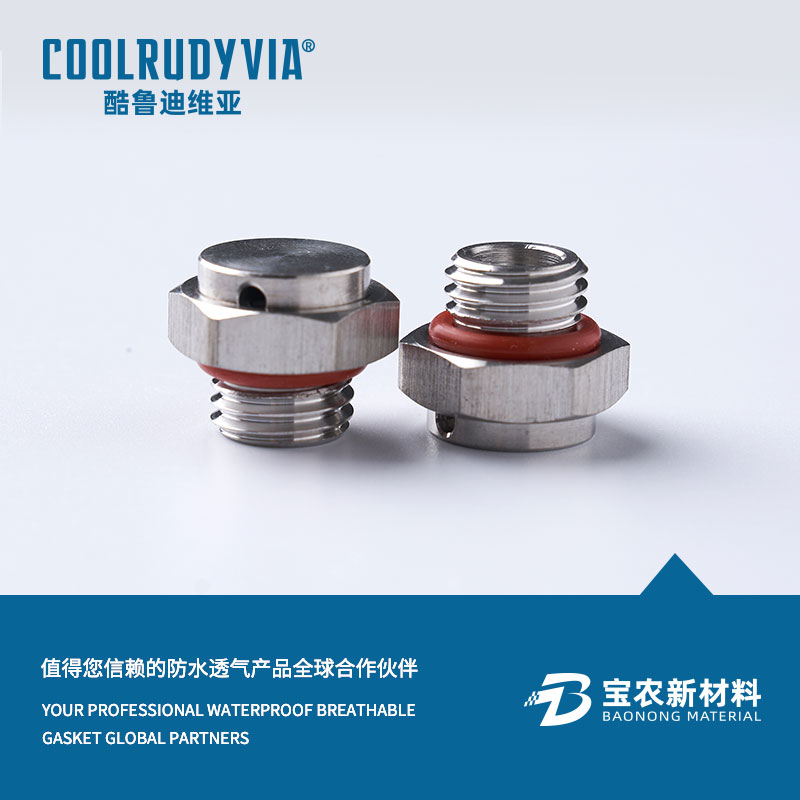 Stainless Steel Vent Plug Manufacturers, Breather Plugs FactoryChangzhou Baonong Is China Stainless Steel Vent Plug Manufacturers, Breather Plugs Factory, We Offer Custom Stainless Steel Waterproof Br...View Product →Custom Aluminum Alloy Breather Vent Plug Manufacturers, FactoryChangzhou Baonong Is China Aluminum Alloy Breather Vent Plug Manufacturers, Factory, We Offer Custom Aluminum Alloy Waterproof Breather V...View Product →
Where Threaded Vent Plugs Earn Their Place
Threaded vent plugs belong wherever a sealed enclosure faces temperature swings, altitude changes, or washdown exposure. Outdoor electronics are the clearest case: on a sunny day, a dark housing can climb 40 °C above ambient. Without venting, the internal pressure spike stresses gaskets, and the reverse pressure during cooling can pull water in. When mounted on the side of an enclosure, threaded vent plugs are suitable for outdoor use because runoff and gravity keep the membrane face clear.
Automotive applications are just as demanding. Headlamp assemblies, control modules, and battery housings cycle between extreme cold and under-hood heat; a vent here prevents the differential pressure that deforms seals, fogs lenses, or cracks housings. The automotive vent plug selection guide walks through the specific tests and airflow values that matter in vehicle environments. The same logic extends to industrial control cabinets, LED drivers, and shipping containers that move through changing altitudes in transit.
Any sealed volume is a miniature pressure vessel. Its gaskets, fasteners, and walls are designed for a certain differential. A threaded vent plug keeps the differential near zero, so the product's own seals can focus on their primary job: keeping water out.
How to Select the Right Threaded Vent Plug
Selection reduces to a few measurable specifications. Work through them in order, and the right plug becomes obvious.
Airflow and Pressure Equalization Rate
The vent's airflow rating — typically given in ml/min at a defined pressure differential such as 100 mm H2O — must match the enclosure volume and the rate of temperature or altitude change. A large enclosure that heats quickly needs a higher venting rate than a small one that cycles slowly. If the airflow is too low, the pressure differential still builds up; if it is oversized, the extra cost rarely buys anything.
Sealing and IP Protection
Check how the plug seals at the interface and what IP rating the assembled unit actually holds. An O-ring flange design can maintain IP67 or IP68 at the plug location; a thread-sealant-only design may not. In food-processing or high-pressure washdown lines, look for IP69K-rated construction and verify it against the standard. The waterproof vent plug selection and installation guide covers how to evaluate these claims and install for reproducible results.
Operating Temperature and Chemical Exposure
The ePTFE membrane is chemically stable across a wide range, but the body and sealing material define the operating window. Plastic bodies soften near their heat-deflection temperature; aluminum and stainless steel handle higher continuous heat. Confirm low-temperature behavior as well — an O-ring that stiffens at -40 °C can leak once an enclosure is cold-soaked and then pressurized. Field-level checks like the ones in this analysis of whether waterproof vent plugs really work confirm performance across the full range.
Before you finalize a part number, confirm four values:
- Thread form and pitch, matched to the drilled and tapped hole
- Interface seal type: integral O-ring, gasket, or thread sealant
- Airflow rating at a defined pressure differential
- IP rating and temperature range of the assembled unit
A threaded vent plug is not a commodity cap. It is a tuned component that combines membrane performance with mechanical mounting. Choose the thread form and interface seal first, match the body material to the enclosure and environment, then verify airflow and IP performance against your real operating profile. A capable supplier should show the membrane construction, the thread tolerance, and the test data behind the rating. Get these decisions right, and the vent becomes an invisible reliability feature: the enclosure stays dry, pressure stays balanced, and gaskets stay where they are supposed to be.

-
Phone Number
+86 138 6105 7907
-
Address
No. 58 Fengjiatou, Xiaoliu Village, Luoyang Town, Wujin District, Changzhou, Jiangsu, China
Copyright © Changzhou Baonong New Material Technology Co., Ltd.All rights reserved
PrivacyCustom Waterproof Breathable Membranes/Gaskets/Plugs/Caps