
 English
 中文简体
中文简体 Español
 عربى
عربى
Can a Seal Actually Breathe? How Does a Waterproof Breathable Plug Work?
 2026.04.23
 Industry News
Content
Most engineers assume that waterproofing means total sealing. In practice, a fully sealed enclosure creates its own failure mode. Temperature swings generate internal pressure differentials that stress gaskets, pull in moisture through micro-gaps, and accelerate condensation on sensitive electronics. A waterproof breathable plug solves this contradiction. It blocks liquid water and contaminants while allowing air and water vapor to pass freely. This article explains the physics behind the technology, the materials involved, and how procurement teams should evaluate options for specific applications.
The Core Problem — Why Sealed Enclosures Need to Vent
Pressure Differential and Condensation Risk
Every enclosed device experiences thermal cycling during normal operation. When internal temperature rises, air expands and pressure builds. When the device cools — at night or after shutdown — pressure drops below ambient. This negative pressure differential acts as a suction force on any imperfection in the seal. Even a gasket rated to IP67 can allow ingress over repeated cycles if the internal-to-external pressure delta exceeds the dynamic sealing capacity of the joint. Condensation follows the same logic: warm, humid air enters through micro-gaps, then cools and deposits liquid water on circuit boards and connectors.
How Water Ingress Happens Without Venting
- Thermal pump effect: Repeated pressure cycling draws external air — and any entrained moisture — inward through the weakest sealing point.
- Differential humidity ingress: High external relative humidity combined with lower internal vapor pressure drives moisture migration across imperfect seals.
- Submersion pressure: Even brief submersion at 1 m depth imposes a 0.1 bar overpressure on the enclosure, sufficient to overcome marginal gasket contact force.
What Is a Waterproof Breathable Plug?
Definition and Basic Structure
A waterproof breathable plug is a venting component consisting of a microporous membrane bonded to a housing — typically threaded or snap-fit — that installs directly into a port on the enclosure wall. The membrane is the functional element. Its pore size is engineered to fall between the diameter of a water droplet (greater than 100 micrometers) and the diameter of an air molecule (approximately 0.37 nanometers). This size selectivity allows gas molecules to pass while surface tension prevents liquid water from penetrating.
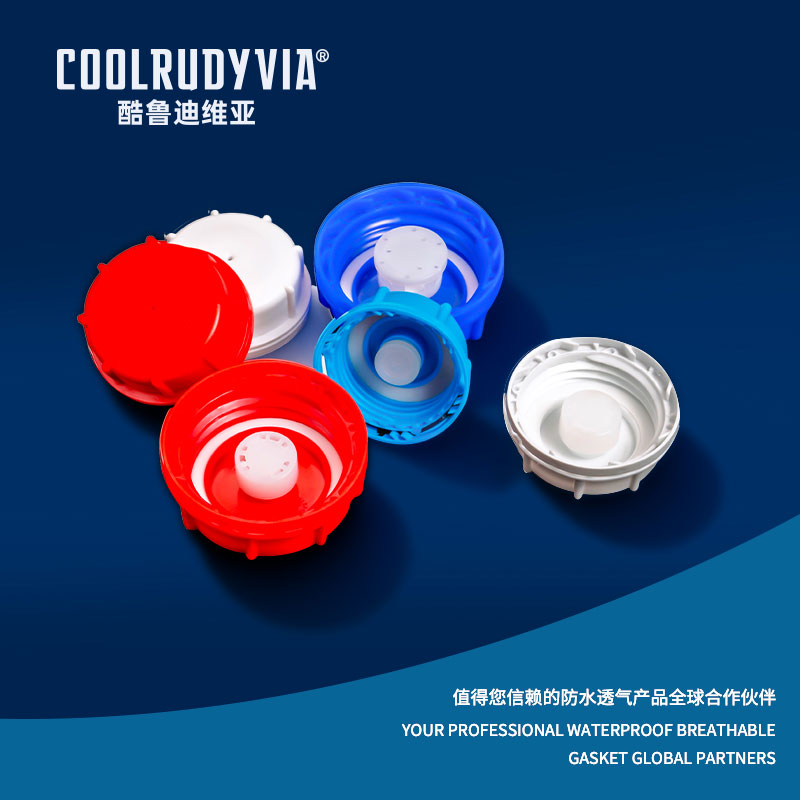
Breathable Vent Plug Pressure Equalization Function
The breathable vent plug pressure equalization function operates passively — no moving parts, no power input. As internal pressure rises above ambient, air flows outward through the membrane. As internal pressure drops, filtered ambient air flows inward. This bidirectional passive venting keeps the internal-to-external pressure differential within a narrow band, typically plus or minus 0.005 to 0.02 bar for standard ePTFE membrane plugs. Maintaining this balance eliminates the suction-driven ingress mechanism and extends the effective service life of primary gasket seals.
Membrane Materials and IP Rating
ePTFE vs Polyethylene Membrane
Two membrane materials dominate the market: expanded polytetrafluoroethylene (ePTFE) and oriented polyethylene (PE). ePTFE is produced by mechanically stretching PTFE resin to create a node-and-fibril microstructure with pore sizes typically in the 0.1–10 micrometer range. Polyethylene membranes are produced by thermally induced phase separation (TIPS) and offer lower material cost at the expense of reduced chemical resistance.
Waterproof Breathable Plug IP Rating and Membrane Material
The waterproof breathable plug IP rating and membrane material relationship is direct: higher-grade membranes enable higher IP classifications. An ePTFE membrane with a 0.2-micrometer nominal pore size, combined with a properly sealed housing, can support IP67 (1 m immersion for 30 minutes) and IP68 (continuous immersion beyond 1 m) ratings. PE membranes are typically limited to IP54 or IP65 in static pressure tests. The table below compares the two primary membrane types across procurement-relevant parameters:
| Parameter | ePTFE Membrane | Polyethylene (PE) Membrane |
|---|---|---|
| Pore Size Range | 0.1 – 10 micrometers | 0.2 – 20 micrometers |
| Max Achievable IP Rating | IP68 / IP69K | IP54 – IP65 |
| Operating Temperature | -70°C to +260°C | -40°C to +90°C |
| Chemical Resistance | Excellent (acids, bases, solvents) | Moderate (limited solvent resistance) |
| Air Flow Rate (typical) | 0.5 – 5 cm3/min at 1 mbar | 2 – 15 cm3/min at 1 mbar |
| Relative Material Cost | High | Low to Medium |
Breathable Plug vs Silicone Vent Plug Comparison
Structural and Functional Differences
A breathable plug vs silicone vent plug comparison reveals fundamentally different operating principles. A silicone vent plug — sometimes called a check valve vent — uses a molded elastomeric flap or dome that opens under outward pressure and closes under inward pressure or liquid contact. It provides one-directional pressure relief rather than continuous bidirectional equalization. A membrane-based waterproof breathable plug vents continuously in both directions and provides certified liquid ingress protection at the membrane surface. The table below summarizes the key differences:
| Feature | Waterproof Breathable Plug (Membrane) | Silicone Vent Plug (Check Valve) |
|---|---|---|
| Venting Direction | Bidirectional (continuous) | Unidirectional (outward only) |
| Water Ingress Protection | IP67 – IP68 (ePTFE) | IP54 – IP65 (varies by design) |
| Condensation Control | Effective | Limited |
| Moving Parts | None | Yes (elastomeric flap) |
| Service Life | 5 – 10 years (application dependent) | 2 – 5 years (fatigue dependent) |
| Unit Cost | Medium to High | Low |
Key Application Scenarios
Waterproof Breathable Plug for Outdoor LED Lighting and Automotive
The waterproof breathable plug for outdoor LED lighting and automotive segmentssharese similar thermal cycling profiles. Automotive headlamp housings, taillights, and electronic control unit (ECU) enclosures experience internal temperature swings of 60–100°C between cold start and full operating temperature. LED street lighting fixtureare s mounted outdoors through similar ranges daily. In both cases, a membrane vent equalizes pressure without allowing road spray, rain, or car wash water to penetrate. Automotive-grade plugs are additionally required to pass salt spray testing (ISO 9227) and vibration endurance tests per relevant OEM specifications.
Waterproof Breathable Plug for Electronic Enclosures
Industrial control panels, junction boxes, and battery management system (BMS) enclosures deployed outdoors represent the core market for the waterproof breathable plug for electronic enclosures segment. These installations often remain sealed for years between service intervals. Without pressure equalization, cumulative thermal cycling causes gasket creep and compression set, progressively reducing the sealing force at the enclosure joint. A single membrane plug — typically M12, M16, or M20 thread — can protect an enclosure volume of up to several liters with negligible maintenance burden.
Selection Criteria for B2B Procurement
Dimensional and Thread Standards
- Thread type: Metric (M12 x 1.5, M16 x 1.5, M20 x 1.5) and NPT (1/8 inch, 1/4 inch) are the most common. Confirm thread standard before ordering for export markets.
- Installation torque: Most housings specify 1.5–3.5 Nm installation torque. Over-torquing can crack the housing or distort the membrane seal.
- Protected area per plug: Manufacturer datasheets specify maximum enclosure volume per vent. Oversized enclosures may require multiple vents to achieve the rated equalization speed.
Environmental and Chemical Resistance Requirements
- UV stabilization: Housings intended for outdoor use must be manufactured from UV-stabilized polyamide (PA66-GF) or polypropylene. Standard PA66 degrades under prolonged UV exposure.
- Chemical compatibility: ePTFE membranes resist most industrial chemicals. Verify compatibility when the enclosure operates near aggressive solvents, cutting fluids, or cleaning agents.
- Oil mist environments: Standard hydrophilic membranes can become partially blocked by oil aerosols. Oleophobic-treated ePTFE membranes are required in compressor or gearbox enclosure applications.
FAQ
Q1: Will a waterproof breathable plug lose its effectiveness over time?
Membrane performance does degrade under specific conditions. Contamination by oils, surfactants, or fine particulate can partially block pores and reduce airflow. Physical damage from incorrect installation torque or impact can rupture the membrane. Under normal conditions in a clean industrial or automotive environment, an ePTFE membrane plug maintains rated performance for 5–10 years. Annual visual inspection and periodic airflow verification against the manufacturer's baseline specification are recommended for critical enclosures.
Q2: Can I use a waterproof breathable plug in a submerged application?
Yes, provided the plug carries the appropriate IP rating for the submersion depth and duration. IP67-rated membrane plugs are designed for temporary immersion at 1 m for up to 30 minutes. IP68-rated plugs are suitable for continuous submersion at depths specified by the manufacturer — commonly 1.5 m to 3 m. The membrane functions by relying on the surface tension of water to prevent liquid penetration. This mechanism remains effective under moderate hydrostatic pressure, but the housing seal and thread engagement must also be rated for the same conditions.
Q3: How many breathable vent plugs does an enclosure require?
One plug is sufficient for most standard enclosures up to approximately 10–20 liters internal volume, depending on the rate of thermal cycling and the airflow rating of the membrane. Larger enclosures, or those subject to rapid temperature changes, may require two plugs installed at opposing high and low points to promote convective airflow and improve equalization speed. The manufacturer's application guide typically provides enclosure volume limits per plug model based on the maximum allowable pressure differential for the installed gasket system.
References
- International Electrotechnical Commission. IEC 60529: Degrees of Protection Provided by Enclosures (IP Code). Edition 2.2. IEC, Geneva, 2013.
- International Organization for Standardization. ISO 9227: Corrosion Tests in Artificial Atmospheres — Salt Spray Tests. ISO, Geneva, 2017.
- Bhave, R.R. Inorganic Membranes: Synthesis, Characteristics and Applications. Van Nostrand Reinhold, New York, 1991. Chapter 3: Membrane Pore Structure and Gas Transport.
- European Commission Joint Research Centre. Best Available Techniques Reference Document for the Surface Treatment of Metals and Plastics (STM BREF). JRC, Seville, 2006. Section on enclosure protection standards.
- Gore, W.L. and Associates. ePTFE Membrane Technology Overview: Principles of Waterproof Breathable Performance. Technical white paper reference, publicly cited in: Journal of Membrane Science, Vol. 187, Issues 1–2, 2001, pp. 1–39. Elsevier.
- DIN Deutsches Institut für Normung. DIN 40050-9: Road Vehicles — Degrees of Protection (IP Code) — Protection Against Foreign Objects, Water and Access — Electrical Equipment. Beuth Verlag, Berlin, 1993.

-
Phone Number
+86 138 6105 7907
-
Address
No. 58 Fengjiatou, Xiaoliu Village, Luoyang Town, Wujin District, Changzhou, Jiangsu, China
Copyright © Changzhou Baonong New Material Technology Co., Ltd.All rights reserved
PrivacyCustom Waterproof Breathable Membranes/Gaskets/Plugs/Caps