
 English
 中文简体
 Español
 عربى

Plastic Breather Vent Plug: A Complete Selection Guide for OEMs and Engineers
 2026.09.10
 Industry News
Content
- 1 What Is a Plastic Breather Vent Plug?
- 2 Critical Specifications to Review Before You Buy
- 3 Plastic vs. Metal Breather Plugs: An Engineering Trade-Off
- 4 Installation Best Practices for Maximum Seal Reliability
- 5 Real-World Use Cases in Automotive, Packaging, and Electronics
- 6 Common Sourcing Mistakes That Destroy Reliability
- 7 Frequently Asked Questions
An outdoor lighting manufacturer saw a 12 percent failure rate in IP65-rated enclosures after the winter shipping season. The cause was not seal leakage; it was condensation created by rapid temperature and altitude swings. A properly selected Plastic Breather Vent Plug prevents exactly this failure mode by allowing pressure equalization while blocking water, dust, and oil. Changzhou Baonong New Material Technology Co., Ltd. (COOLRUDYVIA) has produced these components for over eight years in a 6,000-square-meter standardized workshop using more than 90 automated production machines.
What Is a Plastic Breather Vent Plug?
A Plastic Breather Vent Plug is a compact pressure-regulating device that uses an expanded polytetrafluoroethylene (ePTFE) membrane to let air move in and out of a sealed enclosure while keeping liquid, dust, and oil out.
The plug consists of a plastic housing, usually made of Nylon, Polycarbonate (PC), or POM, with a microporous ePTFE membrane sealed inside. The membrane contains millions of micropores that are hundreds of times larger than gas molecules but significantly smaller than water droplets. This physical structure creates an auto-valve effect: gas molecules pass through freely, while liquid and solid contaminants are pushed against the hydrophobic membrane surface and return to the outside.
Why choose a plastic housing? Plastic plugs are 40 to 60 percent lighter than their aluminum counterparts and avoid the galvanic corrosion that develops when a metal component sits directly against a carbon-fiber or aluminum enclosure. For OEMs scaling production, plastic also lowers the per-unit cost by 20 to 30 percent without reducing IP protection.
 Lightweight and Cost-Effective Plastic Breather Vent Plug for Outdoor EnclosuresThis plastic vent plug offers a lightweight, corrosion-resistant solution for outdoor electronics and lighting, reducing costs while maintaining reliable IP protection for general outdoor environments.View Product →
Critical Specifications to Review Before You Buy
You select a plastic breather vent plug by matching four variables: airflow rate, water entry pressure, operating temperature range, and chemical compatibility.
Airflow rate is the volume of air that passes through the membrane per minute at a standard differential pressure, typically measured at 1 psi (6.9 kPa). A too-low airflow causes the enclosure to experience a slow pressure differential, eventually blowing out the gasket. Water Entry Pressure (WEP), measured in kPa, is the hydrostatic pressure that the membrane resists before a water droplet is forced through. A WEP of 30 kPa is typically required for an IP68 rating at 1 meter submersion. Operating temperature range matters because polycarbonate loses impact resistance below -30C, while the ePTFE membrane remains stable down to -40C.
| Parameter | Typical Range | Performance Impact |
| Airflow rate | 150 - 700 ml/min at 1 psi | Determines pressure equalization speed |
| Water entry pressure | 20 - 50 kPa | Determines IP68 / IP69K waterproofing |
| Operating temp | -40C to +120C | Prevents housing cracking and membrane failure |
| Membrane material | ePTFE (with oleophobic coating) | Blocks oil, pesticides, and solvents |
| Housing material | Nylon, PC, POM, PPS | Defines mechanical strength and UV resistance |
Data based on COOLRUDYVIA standard product lines. Custom ePTFE membranes are available for specific industries.
As the chart shows, airflow scales linearly with the effective membrane area. If your enclosure has a large free air volume (for example, a 10-liter junction box), you will need a plug with a 30 mm2 or 40 mm2 membrane to prevent pressure buildup during fast temperature cycling.
Plastic vs. Metal Breather Plugs: An Engineering Trade-Off
When your enclosure uses a composite, plastic, or non-electrically-conductive housing, a plastic breather vent plug is the better choice because it removes galvanic corrosion and reduces thermal bridging.
Plastic Breather Vent Plug
- 40 - 60 percent lighter than metal, reducing shipping and assembly weight.
- Non-conductive: no galvanic corrosion when mounted in aluminum or carbon-fiber frames.
- Lower unit cost by 20 - 30 percent for high-volume OEM production.
- Easier press-fit and snap-in installation without thread locking compounds.
The final decision should not be based on price alone. If the service temperature consistently exceeds +140C, or if the plug must survive heavy cyclic shock loading, choose a metal plug despite the higher cost. For anything else, a plastic plug provides a faster, cleaner, and more economical path to IP68 protection.
Durable Aluminum Alloy Breather Vent Plug for High-Temperature and Shock LoadsDesigned for demanding conditions, this aluminum alloy plug withstands temperatures above +140°C and cyclic shock, providing cost-effective waterproofing for applications requiring metal robustness.View Product → 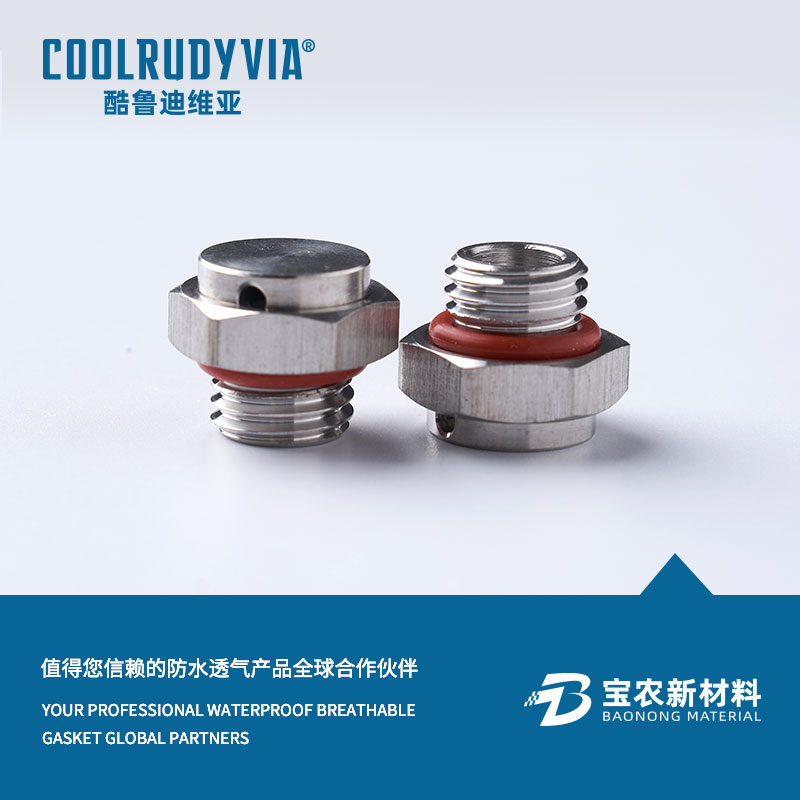 Corrosion-Resistant Stainless Steel Vent Plug for Harsh Coastal EnvironmentsIdeal for coastal and highly corrosive areas, this stainless steel plug delivers stable waterproof and breathable performance, ensuring long-term reliability for outdoor electronic and lighting systems.View Product →
Installation Best Practices for Maximum Seal Reliability
The most reliable installation for a plastic breather vent plug is a controlled press-fit into a precisely drilled hole, or a threaded engagement using a sealant. Improperly installed plugs account for the majority of leakage complaints in the field.
- Drill or mold the hole to the exact diameter specified by the plug datasheet. A common tolerance for press-fit plugs is +/- 0.1 mm from the nominal diameter.
- Deburr and clean the drilled edge. An irregular edge will cut into the hydrophobic membrane or the sealing gasket during insertion.
- Insert the plug with a flat-tipped plunger. Pushing on the edge of a plastic plug can tilt it and permanently deform the ePTFE membrane.
- For threaded versions, apply a torque of 8 - 10 N-m. Over-torquing a Nylon or POM housing beyond 12 N-m shifts the thread and cracks the plug body.
Changzhou Baonong New Material Technology Co., Ltd. provides custom insertion tooling to ensure consistent depth across large production batches, which reduces the risk of operator-induced variation.
Real-World Use Cases in Automotive, Packaging, and Electronics
Plastic breather vent plugs are the standard specification for three high-demand industries: outdoor electronics, liquid and solid packaging, and automotive components.
- Outdoor Electronics: IP68 junction boxes, LED outdoor lighting, EV charging connectors, and solar inverters. The plug prevents condensation during day-night temperature swings and protects circuitry from dust and water. COOLRUDYVIA supplies plastic vent plugs for enclosures that need to meet IEC 60529 high-pressure wash-down tests.
- Liquid & Solid Packaging: Pesticide drums, fertilizer bags, and chemical bottles. A plastic breather vent plug prevents container collapse during altitude changes in shipping and stops internal gas accumulation that would bulge or rupture HDPE bottles. An oleophobic ePTFE membrane keeps pesticide and surfactant molecules from fouling the membrane surface.
- Automotive: Headlamps, battery enclosures, and electronic control units (ECUs). Differential pressure in headlamps is one of the main causes of fogging. A breather plug with a controlled airflow rate keeps the optical chamber dry and clean, contributing to compliance with ISO 16750 and IP67/IP69K for under-hood components.
Changzhou Baonong New Material Technology Co., Ltd. produces three material variants of the vent plug: plastic, aluminum alloy, and stainless steel. The plastic variant is optimized for high-volume applications where cost, weight, and corrosion resistance dictate procurement. For specialized environments, the company moves to a PPS (polyphenylene sulfide) housing to withstand solvents and higher operating temperatures.
Common Sourcing Mistakes That Destroy Reliability
The most damaging sourcing mistake is selecting a plug based on its IP rating alone, without calculating the actual airflow requirement of your enclosure volume and operating temperature swing.
The required airflow (V) is derived from the ideal gas law: V = (ΔP x Vc) / (P_atm x t), where ΔP is the maximum allowable pressure differential, Vc is the free air volume inside the enclosure, P_atm is ambient pressure (101.3 kPa), and t is the time allowed for pressure equalization. If you skip this calculation, the enclosure will experience a pressure differential that exceeds the gasket's clamp force, leading to seal blowout.
A Plastic Breather Vent Plug is a passive pressure equalization device that uses an ePTFE membrane to physically separate air from liquids. It is not a filter; it is a microporous barrier that lets gas molecules pass while preventing water molecules from crossing the membrane surface tension.
Other common mistakes include ignoring chemical compatibility. Standard Nylon and PC housings degrade quickly when exposed to aggressive solvents such as acetone, MEK, or xylene. For pesticide or solvent-based packaging, always choose a POM or PPS housing with a fluoropolymer membrane. Failing to test the IP68 status after installation is another point of failure; compressed air leakage through the plug threads or press-fit void will only show up in a pressure-decay test.
- Do not use a metal plug in an aluminum housing without an insulating gasket. Galvanic corrosion will start within 12 months.
- Do not verify IPx ratings with a water spray test alone. Submersion testing at 1 meter for 30 minutes is mandatory for IP68.
- Do not reuse a press-fit plug after removal. The ePTFE membrane and housing are deformed after insertion and cannot be restored to their original sealing pressure.
Frequently Asked Questions
How do I know the airflow rate of a plastic breather vent plug?
The airflow rate is stated at a standard differential pressure of 1 psi (6.9 kPa). A COOLRUDYVIA plastic vent plug with a 28 mm outer diameter typically passes 500 ml/min at 1 psi. Always verify this figure against the free air volume of your enclosure to ensure the pressure equalizes in your target time window.
What is the difference between a breather plug and a vent cap?
A breather plug is a single self-contained component with a threaded or press-fit base. A vent cap is an outer protective cover that is installed over an inner permeable membrane. Automotive headlamp assemblies commonly use a vent cap to provide mechanical protection, while junction boxes use a plastic breather plug to save space and reduce assembly steps.
Can I clean a plastic breather vent plug with solvents?
Isopropyl alcohol is safe for most plastic breather vent plugs. Aggressive ketones like acetone will attack PC and ABS housings. If solvent exposure is expected, choose a POM or PPS housing, which retains its mechanical properties after prolonged contact with industrial chemicals.
Does a plastic vent plug lose performance over time?
The ePTFE membrane is not clogged by humid air, so its airflow and water entry pressure remain stable in continuous outdoor use. However, the plastic housing can degrade under prolonged UV exposure. For outdoor installations, select a UV-stabilized PC or POM material, and conduct an annual inspection for chipping or stress cracking around the insertion point.

-
Phone Number
+86 138 6105 7907
-
Address
No. 58 Fengjiatou, Xiaoliu Village, Luoyang Town, Wujin District, Changzhou, Jiangsu, China
Copyright © Changzhou Baonong New Material Technology Co., Ltd.All rights reserved
PrivacyCustom Waterproof Breathable Membranes/Gaskets/Plugs/Caps