
 English
 中文简体
 Español
 عربى

Automotive Vent Cap Selection Guide: Airflow, Materials and IP Ratings
 2026.10.08
 Industry News
Content
- 1 What an Automotive Vent Cap Actually Does
- 2 The Physics That Sets Your Automotive Vent Cap Airflow Target
- 3 Which Housing Material: Aluminium Alloy, Plastic or Stainless Steel
- 4 Specifying an Automotive Vent Cap: Six Numbers That Belong on the Datasheet
- 5 Failure Modes That Appear After 200 Hours in Service
- 6 What to Look For in an Automotive Vent Cap Supplier
- 7 Frequently Asked Questions About Automotive Vent Caps
A sealed one litre automotive lamp housing that heats from 20 deg C to 80 deg C develops roughly 20.5 kPa of internal pressure, about a fifth of one atmosphere, and it loads that pressure straight onto the lens, the gasket and the connector seal. The component that releases it is the automotive vent cap, and it is also the component that has to keep water out while doing so.
Sizing that part is a specification exercise, not a catalogue exercise. Airflow, water entry pressure, membrane chemistry, housing material and mounting geometry interact, and changing one of them changes the others.
This guide covers what an automotive vent cap does inside a sealed housing, the physics that sets its airflow target, how aluminium alloy, plastic and stainless steel housings compare, the six numbers that belong on a datasheet, and the failure modes that surface after a few hundred hours in the field.
What an Automotive Vent Cap Actually Does
An automotive vent cap is a pressure equalisation device that lets air move in and out of a sealed enclosure while blocking liquid water, dust and most oil aerosols.
The mechanism matters before the part number does. Typical ePTFE vent membranes carry pores between 0.1 and 1 micron, while a water droplet is thousands of times larger, and the polymer surface energy keeps it from being drawn through even when the housing is pressurised or briefly submerged. That is how a part the size of a shirt button holds IP67 or IP68 and still equalises pressure in seconds.
Sealed housing versus vented housing
- Internal pressure tracks temperature, up to 20.5 kPa at an 80 deg C soak
- Gasket, lens and weld lines carry the full load
- Moisture trapped at assembly never escapes
- Pressure returns to near ambient within seconds
- Seal stress and lens deformation drop sharply
- Water vapour migrates out, so fogging clears
Placement decides more outcomes than the part number does. A vent cap on the top face of a housing that collects rainwater holds a film of water against the membrane for hours; the same cap on a shielded side wall sees splash and drainage only. Water entry pressure is measured against a laboratory column, never against a real splash angle.
The Physics That Sets Your Automotive Vent Cap Airflow Target
The airflow a vent cap needs is fixed by the ideal gas law rather than by supplier preference: a sealed enclosure heated from 20 deg C to 80 deg C gains about 20 percent in absolute pressure, which is 20.5 kPa of gauge pressure at sea level.
Two consequences follow. The vent only has to be fast relative to the thermal ramp, so a cap rated at 200 to 300 ml/min at 70 mbar equalises a one litre housing in seconds while a lamp takes minutes to reach soak temperature. Cooling is the harder half of the cycle: a housing that drops 60 K pulls roughly 20 kPa of vacuum, and that is the moment water is drawn past a marginal gasket or a partly blocked membrane.
Sizing rule: design the vent around the cool-down direction. Pressure relief during heat-up is generous; the vacuum during cool-down is what pulls water into a housing whose vent is clogged.
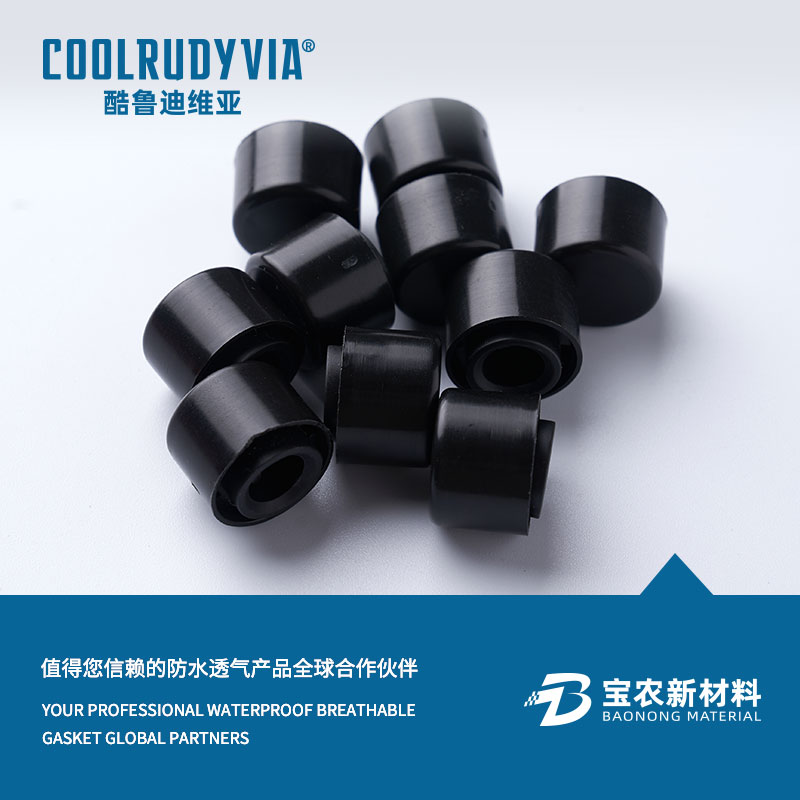 Waterproof ePTFE Vent Membrane for Automotive Headlights and TaillightsAdhesive-backed ePTFE membrane equalizes pressure and blocks water and dust in car lamp housings; review airflow, WEP, and mounting conditions before specifying.View Product →
Which Housing Material: Aluminium Alloy, Plastic or Stainless Steel
All three housing materials use the same ePTFE membrane, so the housing decides corrosion life, mass, mounting strength and cost, and it should be picked from the mounting environment rather than from the bill of materials.
| Material | Corrosion resistance | Service temperature | Mass | Typical position | Relative cost |
| Aluminium alloy | Good, improved by anodising | -40 to +150 deg C | Low | Lamp housings, adhesive-mounted bosses | Low to medium |
| Engineering plastic (PA66, PBT) | Very good with UV stabilisers | -40 to +120 deg C | Lowest | Exterior lamps, sensor and electronics enclosures | Low |
| Stainless steel 304 / 316 | Excellent | -60 to +200 deg C | High | Chassis, underbody, high-vibration zones | Medium to high |
Two material traps worth checking early
- Galvanic coupling. An aluminium housing mounted next to a steel or magnesium bracket corrodes at the interface rather than on the exposed face, so the leak appears where nobody inspects.
- UV ageing. A plastic cap specified without stabilisers embrittles at the mounting boss after a few summers, and a hairline crack there is a water path rather than a cosmetic mark.
Custom Vent Cap for Automotive Lamp HousingsProtects the ePTFE vent membrane from dust, mud, and water while equalizing pressure in headlamps, tail lamps, fog lamps, and other sealed lighting.View Product →Specifying an Automotive Vent Cap: Six Numbers That Belong on the Datasheet
A vent cap datasheet is only comparable when six numbers are quoted together with their test conditions; any one of them on its own lets two very different parts look identical.
- Airflow at a stated differential. Demand a flow rate in ml/min at a defined pressure, usually 70 mbar or 1 kPa. A figure without its reference pressure cannot be compared with anything.
- Water entry pressure. This is the pressure at which liquid water first passes the membrane, typically 100 to 300 kPa for an oleophobic ePTFE vent. It is not the same measurement as the IP rating of the assembly.
- IP rating of the finished enclosure. IP67, IP68 and IP69K apply to the product with the cap installed, tested in the mounting orientation. A loose cap carries no IP rating at all.
- Operating temperature range. State the continuous range and the peak the membrane sees during paint cure, soldering or thermal shock, because peaks set the adhesive specification.
- Chemical and UV exposure. Under-hood fluids, cleaning agents and sunlight attack the housing and the adhesive long before they attack PTFE, so those two are the real limits.
- Mounting method and insertion force. Snap-fit, press-fit, threaded and adhesive caps each need a defined boss geometry and a defined insertion force, or the fit drifts between assembly lines.
Membrane behaviour and part selection are covered in more detail in this walkthrough of how ePTFE vent plugs work and how they are selected.
Failure Modes That Appear After 200 Hours in Service
Four field failures account for almost every vent cap complaint: contamination, blockage, mechanical damage at assembly, and water that was already inside the housing before the cap was fitted.
| Symptom | Likely root cause | Corrective action |
| Fogging after a cold soak | Moisture sealed in at assembly | Control assembly humidity and dry the housing before closing |
| Slow pressure equalisation | Membrane fouled by oil mist or dust | Specify an oleophobic membrane and shield the cap from direct spray |
| Cracked lens or popped seal | Vent blocked, pressure has nowhere to go | Verify airflow at end of line, not only on samples |
| Water ingress after a wash | IP rating claimed for the cap instead of the housing | Test the assembled enclosure in its mounted orientation |
- False alarm: a damp membrane surface after a pressure wash is normal; the question is whether water crosses it, not whether water sits on it.
- Real problem: a cap that passes a bench airflow test but reads low after 200 hours of oil mist exposure has lost its oleophobic treatment, and no cleaning restores it.
What to Look For in an Automotive Vent Cap Supplier
The supplier question that matters most is whether the membrane and the finished housing come from the same process line, because every extra interface adds a leak path that incoming inspection cannot fully catch.
Changzhou Baonong New Material Technology Co., Ltd. describes itself as one of the few integrated manufacturers of waterproof breathable membrane series products, working under its COOLRUDYVIA brand from a 6,000 square metre standard workshop in Changzhou, Jiangsu. The company states that it runs more than 90 automated machines built on its own intellectual property and applies both automated equipment inspection and manual inspection to every part, a two-stage check that matters for a component whose failure mode stays invisible until water arrives.
Three questions separate an integrated manufacturer from a trading operation. Can the supplier show airflow and water entry pressure data per production lot rather than per sample? Is the membrane produced and bonded in the same facility that moulds the housing? And does the supplier run the enclosure-level ingress test, or only a component test? The same membrane platform also appears in the company waterproof breathable plug range, which covers smaller threaded and press-fit ports.
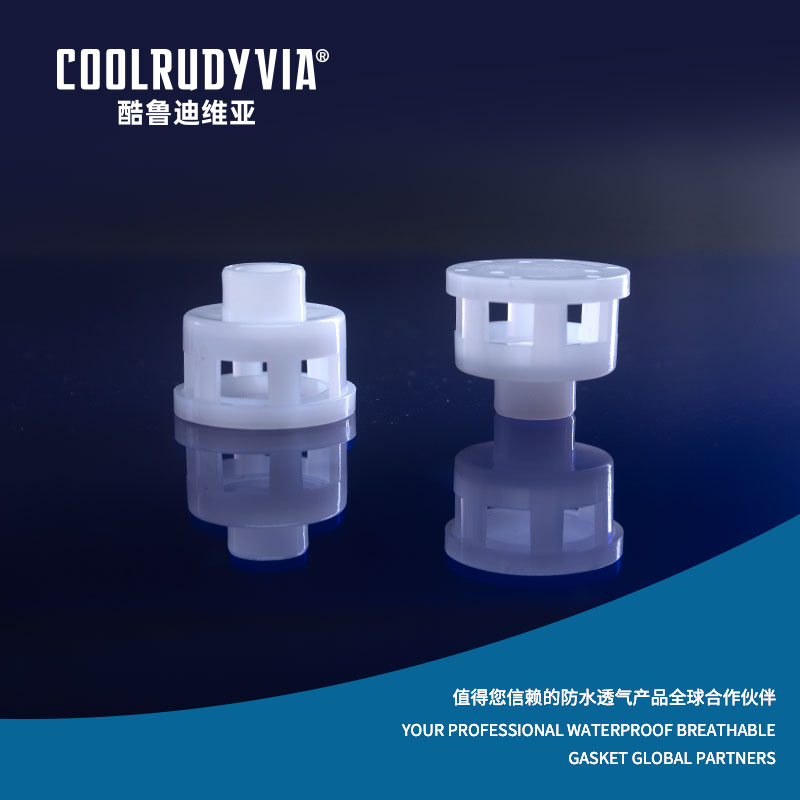 Waterproof Breathable Plug with ePTFE Microporous MembraneThreaded or press-fit vent plug uses ePTFE to equalize pressure and block water, oil, and dust in automotive, electronics, and sealed packaging.View Product →
Frequently Asked Questions About Automotive Vent Caps
What is an automotive vent cap made of?
Almost every automotive vent cap pairs an expanded polytetrafluoroethylene membrane with a housing in aluminium alloy, engineering plastic or stainless steel. The membrane does the breathing and the waterproofing; the housing carries the mounting geometry, the sealing surface and the mechanical strength.
How much airflow does an automotive vent cap need?
Enough to equalise pressure faster than the enclosure temperature changes. In practice a vent rated at 200 to 300 ml/min at 70 mbar equalises a one litre housing in seconds, far quicker than a lamp or sensor housing heats or cools. Always specify the flow rate together with its reference pressure.
Can an automotive vent cap be IP68 rated?
An IP rating applies to the assembled product, not to a loose component. Test the finished housing with the vent cap installed, in the orientation it will be mounted, and state that test condition on the specification. A cap that passes IP68 on a bench can still fail when it is fitted facing upward in a splash zone.
Why not simply drill a small hole instead of fitting a vent cap?
A plain hole equalises pressure, but it also admits water, dust and cleaning chemicals directly. An ePTFE membrane keeps the same airflow path open while its micropores and low surface energy block liquid water, so the housing breathes without an open ingress path.

-
Phone Number
+86 138 6105 7907
-
Address
No. 58 Fengjiatou, Xiaoliu Village, Luoyang Town, Wujin District, Changzhou, Jiangsu, China
Copyright © Changzhou Baonong New Material Technology Co., Ltd.All rights reserved
PrivacyCustom Waterproof Breathable Membranes/Gaskets/Plugs/Caps