
 English
 中文简体
 Español
 عربى

Breathable Breather Plug for Packaging Containers: Sourcing Guide for Buyers
 2026.10.08
 Industry News
Content
- 1 What a Breathable Breather Plug Actually Does in a Packaging Container
- 2 Match Airflow Rate to Container Volume and Headspace
- 3 Housing Materials for a Breathable Breather Plug: Aluminum Alloy, Stainless Steel or Plastic
- 4 Reading IP Ratings and Washdown Claims Without Getting Burned
- 5 A Six-Point Sourcing Checklist for Breathable Breather Plug Buyers
- 6 What to Verify Before You Approve a Packaging Container Manufacturer
- 7 Frequently Asked Questions
A cold-filled PET bottle leaves a 4 C cooler with its cap panel dished inward, because the air sealed inside contracts and drags the liner down into the neck. The reflex fix is a thicker liner. The correct fix is a breather plug sized for the container, the fill temperature and the wash cycle. Specifying a breathable breather plug for packaging containers comes down to reconciling three numbers that fight each other: airflow, ingress protection and installed height above the sealing surface.
What a Breathable Breather Plug Actually Does in a Packaging Container
A breather plug equalizes pressure. It does not seal the container, it does not filter the product and it is not a replacement for a foil liner. It is a small structural component with one narrow job: move air in both directions without letting liquid water, dust or product residue through.
Definition. A breather plug is a pressure-equalization component that couples a hydrophobic microporous membrane, normally expanded polytetrafluoroethylene (ePTFE), with a rigid housing, so that air and water vapor pass freely while liquid water and particles are blocked.
The membrane is the working element. An eGPTFE vent membrane for packaging typically runs a pore size between 0.2 and 1 micron, roughly four orders of magnitude smaller than a water droplet, while its open pore network still allows air to flow. That is why a membrane disc only a few millimetres across can move 150 to 400 millilitres of air per minute at a 1 kPa differential, which is more than enough to keep a beverage bottle in shape during a fast thermal drop.
A drilled hole in the cap achieves the same pressure balance and nothing else. The comparison below is the practical reason packaging engineers pay for the membrane.
Open vent hole
- Equalizes pressure almost instantly
- Lets liquid escape the moment the container tips
- No barrier against dust, insects or wash water
- Cannot pass IPX4, let alone IP68
- Blocks nothing during storage and transport
Membrane breather plug
- Equalizes pressure within seconds, fast enough for high-speed fillers
- Retains the liquid product inside the container
- Blocks particles down to the sub-micron range
- Available rated to IP68 and IP69K
- Survives storage, transport and retail handling without change
The practical consequence: on a line running more than 20,000 bottles per hour, the plug is the only component that protects the container between the filler and the consumer. Everything else in the closure stack is static.
Match Airflow Rate to Container Volume and Headspace
Lock the airflow rate first, because it sets the membrane area, which sets the housing diameter, which sets whether the plug physically fits inside the cap. A plug that moves too little air lets the container deform; a plug that moves too much air lets wash water and volatile actives escape.
The physics is straightforward. A sealed container behaves like a fixed-volume gas cell. A 25 C temperature swing on a 500 ml bottle with 20 ml of headspace produces roughly 38 kPa of differential pressure. If the plug cannot relieve that pressure in a few seconds, the cap panel dishes, the liner lifts, or the base of a thin-wall container creeps outward permanently.
Reference airflow at 1 kPa by container size
Values are typical reference points in millilitres per minute for ePTFE vent plugs. Confirm against your own fill temperature, altitude profile and headspace volume before freezing a drawing.
Size the plug so the differential pressure stays below 5 kPa during the fastest thermal event the product will ever see. That is the threshold where most injection-moulded closures and thin-wall bottles still recover elastically instead of yielding.
Headspace volume matters more than total container volume. Doubling the headspace cuts the required airflow by roughly 40 percent at the same temperature swing, which is why a 1 litre bottle filled to 95 percent needs a larger plug than the same bottle filled to 80 percent.
Housing Materials for a Breathable Breather Plug: Aluminum Alloy, Stainless Steel or Plastic
The membrane is largely the same across qualified suppliers; the housing is where applications diverge. Choose the housing from the chemical environment and the installation method, not from the unit price.
| Housing material | Typical applications | Chemical resistance | Relative cost | Installation method |
| Aluminum alloy | Beverage caps, automotive headlamps, general packaging | Neutral to good; attacked by strong caustic and some agrochemical solvents | Baseline | Press fit or threaded |
| Stainless steel | Food processing, agrochemical packaging, high-pressure washdown zones | Excellent against most acids, bases and solvents | Two to three times aluminum | Threaded or snap ring |
| Engineering plastic | Outdoor electronics housings, lightweight assemblies, cost-driven programs | Depends on resin grade; UV degradation over long outdoor exposure | Lowest | Snap fit, ultrasonic weld or press fit |
Two selection traps show up repeatedly. First, pairing an aluminum housing with a caustic clean-in-place cycle, where the housing pits within a few months even though the membrane is fine. Second, choosing plastic purely on cost for an enclosure that sits on a rooftop for ten years, where UV stabilisation is not optional.
Reading IP Ratings and Washdown Claims Without Getting Burned
IP68 and IP69K test different things, and a supplier report quoting one does not cover the other. If your filling line runs a caustic clean-in-place cycle, ask for IP69K data, not IP68.
IP68 is a continuous immersion test, and the depth and duration are chosen by the manufacturer, so two plugs both marked IP68 can be tested to entirely different severities. IP69K is a high-pressure, high-temperature jet test at 80 C and 80 to 100 bar, applied from four angles at 30 seconds each.
Condensation is the second failure mode that a rating alone does not capture. A sealed outdoor enclosure that swings between day and night temperatures will pull moisture through any path that is not membrane-protected, and that moisture collects at the lowest internal point. A correctly specified plug with adequate water vapor transmission keeps the internal dew point below the enclosure surface temperature, which is the mechanism that actually prevents condensation rather than merely tolerating it.
Ask for the test report, not the rating. A one-page report that names the immersion depth, the duration, the jet temperature and the sample orientation tells you more than a marketing badge ever will.
A Six-Point Sourcing Checklist for Breathable Breather Plug Buyers
Write these six items into the drawing or the purchase specification before you request quotes. A plug that passes bench tests but fails on the filler is almost always a specification gap rather than a manufacturing defect.
- State the pressure envelope. Give the minimum and maximum internal pressure the container will see, including altitude during transport and the thermal shock of the fill cycle.
- Test airflow on the real container. Bench data on a bare membrane disc is not transferable to an assembled plug with a housing, adhesive and protective mesh.
- Fix the installed height. The plug must sit below the cap skirt and above the sealing land, with a tolerance stack that accounts for cap torque and liner compression.
- Lock the membrane grade and the housing polymer in writing. Grade substitutions are the most common source of silent performance drift between lots.
- Agree on the inspection method. Airflow sampling, immersion testing and dimensional checks should be named, with sampling frequency and acceptance limits.
- Demand lot traceability on the reel or tray. If a defect appears six months later, membrane batch identity is the only way back to the root cause.
A specification that omits the fill temperature has no airflow target, and a specification with no airflow target cannot be verified on an incoming inspection bench.
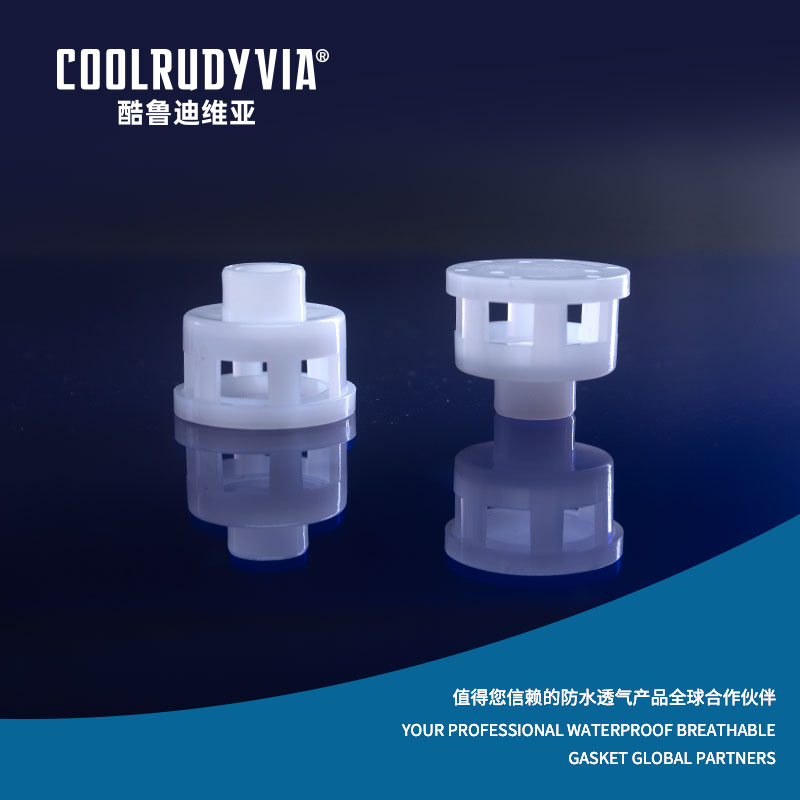 Waterproof Breathable Plug with ePTFE Pressure-Equalizing MembraneWaterproof breathable plug with ePTFE membrane balances enclosure pressure and blocks water, oil, dust, and particles for sealed automotive components.View Product →
What to Verify Before You Approve a Packaging Container Manufacturer
Treat a supplier's self-description as the starting point and verify three things: the membrane-to-structure manufacturing chain, the automated inspection regime, and the ability to run custom validation for your application.
Changzhou Baonong New Material Technology Co., Ltd., which markets its vent products under the COOLRUDYVIA brand, describes itself as an integrated manufacturer rather than a membrane supplier alone. The company states that it operates more than 6,000 square metres of industrial standard workshop space and over 90 sets of proprietary automated equipment, covering design, development, production and sales for breathable gaskets, plugs and covers. For a buyer, the relevant question is whether that vertical integration removes a subcontracting step that would otherwise introduce an uncontrolled variable between the membrane and the finished component.
Verification points. Ask for the membrane lot record, the automated inspection logs for the plug body, and the artificial inspection criteria applied after automation. A dual inspection regime only has value if the second stage is documented and reproducible.
The company also states that it provides custom development and compliance testing for automotive applications, where every part number typically carries its own validation protocol. Buyers evaluating a first order should request a sample run against their own pressure and washdown profile rather than accepting a catalogue number. A breathable plug for packaging containers guide published by the manufacturer is a useful starting point before the first request for quotation, but it does not replace a line trial on your own container.
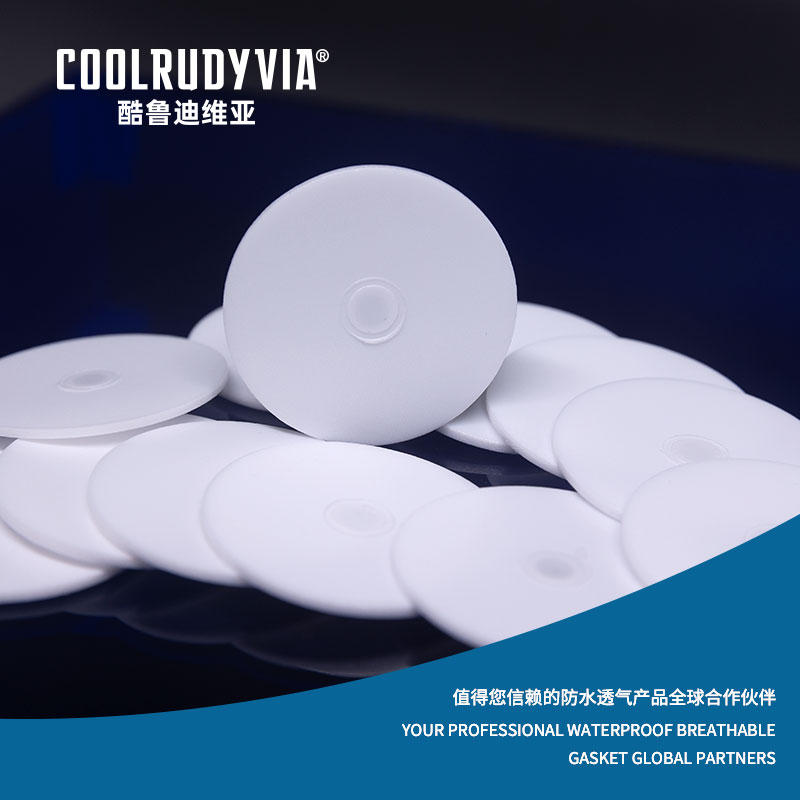 Waterproof Breathable Gasket for Bottle and Container SealingAluminum foil breathable gasket combines sealing foil with a hydrophobic microporous membrane to balance container pressure while blocking liquids, microorganisms, and particulates.View Product →
Frequently Asked Questions
What airflow rate does a 1 litre packaging container need?
Target 200 to 300 millilitres per minute at 1 kPa for most 1 litre containers. That keeps peak pressure below 5 kPa during a thermal shock, which thin-wall PET can recover from elastically. If your headspace is larger than 20 percent of total volume, re-test at a lower figure instead of copying the number, because doubling the headspace reduces the required airflow by roughly 40 percent.
Can a breather plug replace an induction seal liner?
No. The plug balances pressure; it does not provide a hermetic seal against leakage or oxygen ingress. A foil seal liner protects the product before first opening, while the breather path takes over afterward. In many caps the two coexist: the liner sits on the sealing land and the vent sits in the cap panel above it.
Is ePTFE the only membrane material used in breather plugs?
No. Sintered polyethylene and polyurethane-based membranes appear in lower-cost products. ePTFE delivers higher porosity and therefore more airflow per unit area, plus better temperature and chemical resistance, which is why it becomes the default once wash temperatures exceed 60 C or the contents are agrochemicals. For short-shelf-life dry powders with no washdown, sintered polyethylene can be acceptable on cost grounds.
How do I test a breather plug on my own line?
Run two checks. First, fill the container to the target level, cool it from 40 C to 4 C, then inspect for cap panel deformation and liner displacement. Second, subject the same container to a ten-minute high-pressure jet at 80 C, then open the cap and look for visible moisture on the inner face of the membrane. Together these take under an hour and eliminate most mis-specified plugs before they reach production.

-
Phone Number
+86 138 6105 7907
-
Address
No. 58 Fengjiatou, Xiaoliu Village, Luoyang Town, Wujin District, Changzhou, Jiangsu, China
Copyright © Changzhou Baonong New Material Technology Co., Ltd.All rights reserved
PrivacyCustom Waterproof Breathable Membranes/Gaskets/Plugs/Caps