
 English
 中文简体
 Español
 عربى

ePTFE Vent Plug for Automotive Manufacturers: Selection & Validation Guide
 2026.10.01
 Industry News
Content
- 1 What an ePTFE Vent Plug Does in an Automotive Assembly
- 2 Why Unvented Housings Fail Field Testing
- 3 Specifications Automotive Manufacturers Must Lock Before Tooling
- 4 Mounting Formats and Where Each One Belongs
- 5 Validation Sequence from DV to PPAP
- 6 Sourcing ePTFE Vent Plugs as a Tier Supplier
- 7 ePTFE Vent Plug Questions Automotive Buyers Ask Most
An automotive headlamp sealed to IP67 can still fog from the inside after a single cold night. The lens is not leaking. A sealed housing has nowhere to send the pressure difference created by a 25 C temperature drop, so the trapped air contracts, draws moist air past the seal lip, and condenses on the coldest surface inside the optics. That is the failure an ePTFE vent plug is specified to prevent, and it is why automotive manufacturers now treat the vent as a functional component rather than a cheap accessory.
Specification conversations usually start with five questions: what pressure differential has to be equalized, what water and dust must be blocked, what fluids and temperatures the part will see, how the plug is retained in the housing, and how airflow will be verified in mass production. Answer those five and the membrane grade, housing material, and mounting style narrow themselves.
What an ePTFE Vent Plug Does in an Automotive Assembly
An ePTFE vent plug is a microporous expanded polytetrafluoroethylene membrane sealed into a housing, cap, or threaded body. It equalizes pressure between a sealed automotive enclosure and the outside atmosphere while keeping liquid water, dust, and oil mist outside.
Definition: an ePTFE vent plug is a pressure-equalization component in which a hydrophobic expanded polytetrafluoroethylene membrane, usually 0.1 to 1 micron pore size, is bonded, welded, or over-molded into a rigid or elastomeric body that installs into an automotive housing.
How the Membrane Blocks Water Yet Passes Air
Water only enters a housing when there is a continuous liquid path to follow. An ePTFE membrane offers none. Its pore network is small enough that surface tension holds a water column out at pressures far above anything a vehicle generates. A plug rated at 500 mbar water entry pressure resists roughly 5 meters of standing water head, and oleophobic grades push that number past 1,500 mbar while still passing air at tens to hundreds of milliliters per minute.
How Much Pressure a Sealed Housing Really Builds
In a sealed, constant-volume enclosure the internal pressure tracks temperature almost linearly. At sea level, a sealed housing sees about 3.5 mbar of pressure change for every 1 C of temperature change. A headlamp that reaches 80 C in operation and cools to -20 C overnight swings more than 300 mbar. A 1,000 meter altitude change adds roughly 100 mbar on top. A correctly sized vent plug equalizes that range in seconds, not hours.
Why Unvented Housings Fail Field Testing
Unvented housings rarely fail by flooding. They fail by condensation, seal creep, and optical fogging, which is why an ingress test run on a cold, dry sample can pass while the same part fails in service.
Sealing the housing more tightly does not solve the problem; it moves the pressure load onto the seal and the weakest structural joint. The comparison below shows the water entry pressure each strategy can hold.
| Strategy | Water entry pressure | Pressure equalization | Typical field outcome |
| Solid wall, no vent | Highest | None | Condensation, seal creep, lens fogging |
| Drilled hole or pinhole | Near zero | Fast | Water, dust, and wash-down ingress |
| Labyrinth or tortuous path | Low | Slow | Partial protection, dust bridging over time |
| ePTFE vent plug | 500 to 2,000 mbar | Fast, within seconds | Stable internal pressure, dry optics |
Specifications Automotive Manufacturers Must Lock Before Tooling
Six numbers decide whether a vent plug survives the vehicle: ingress rating, airflow, water entry pressure, temperature window, fluid resistance, and retention force. Lock them before the housing tool is cut, because changing a bore diameter after tooling costs far more than changing a membrane grade.
| Parameter | Typical automotive requirement | Reference |
| Ingress protection | IP67 minimum; IP68 or IP69K for underbody and engine bay | IEC 60529, ISO 20653 |
| Airflow | 50 to 500 ml/min at 70 mbar for a 10 mm plug | Supplier specification |
| Water entry pressure | 500 mbar minimum; 1,500 mbar for oleophobic grades | Internal pressure ramp test |
| Temperature range | -40 to +125 C continuous, 150 C peaks | ISO 16750-4 |
| Thermal shock | 200 cycles from -40 to +85 C | ISO 16750-4 |
| Vibration | 10 to 2,000 Hz, up to 20 g | ISO 16750-3 |
| Corrosion | 480 hours neutral salt spray | ISO 9227 |
| Retention | 100 N minimum pull-out for press-fit bodies | Internal axial pull test |
Airflow is the number that quietly drifts. A membrane that loses 40 percent of its airflow after thermal cycling still passes an immersion test, yet it will fog optics and stress seals within two winters.
Mounting Formats and Where Each One Belongs
Mounting choice follows the housing wall, not the membrane. Press-fit suits thin molded plastic, snap-fit suits high-volume automated assembly, screw-in suits serviceable or high-vibration locations, adhesive suits flat covers, and welded bodies suit battery trays where seal integrity outranks assembly speed.
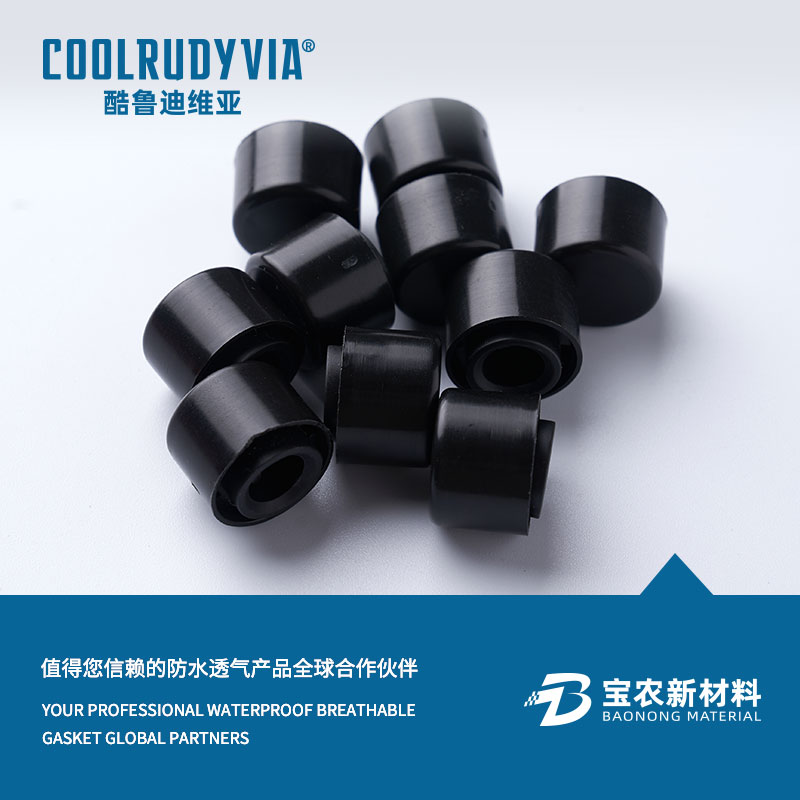
 Custom Vent Cap for Automotive Lamp HousingsThis vent cap shields the waterproof breathable membrane from dust, mud, and water while preserving long-term airflow. It suits various mounting methods, with validation that checks airflow at every stage.View Product →
| Format | Typical location | Installation | Trade-off |
| Press-fit | Headlamp housing, sensor body | Axial press into a molded bore | Low unit cost, tight bore tolerance required |
| Snap-fit | ECU covers, small enclosures | Click into a molded boss | Fast assembly, tooling investment |
| Screw-in | Battery pack, motors, pumps | Torque to specification | Serviceable, higher unit cost |
| Adhesive | Flat covers, camera modules | Automated placement and cure | Limited temperature window |
| Welded | Battery trays, sealed housings | Ultrasonic or heat weld | Highest seal integrity, capital cost |
Validation Sequence from DV to PPAP
Validation runs in five stages, and airflow is re-measured at every stage. A membrane that survives a test but loses half its airflow has failed, even if it never leaks.
- Membrane qualification: bubble point and airflow checks on incoming membrane rolls.
- Component ingress testing: IP67 immersion at 1 meter for 30 minutes, followed by an IP69K high-pressure hot water jet where the specification requires it.
- Thermal and pressure cycling: 200 cycles from -40 to +85 C with airflow measured before and after.
- Fluid and corrosion exposure: salt spray, engine oil, coolant, and washer fluid soaks, followed by water entry pressure re-testing.
- Production validation: process capability studies on airflow and pull-out force, plus documentation for PPAP submission.
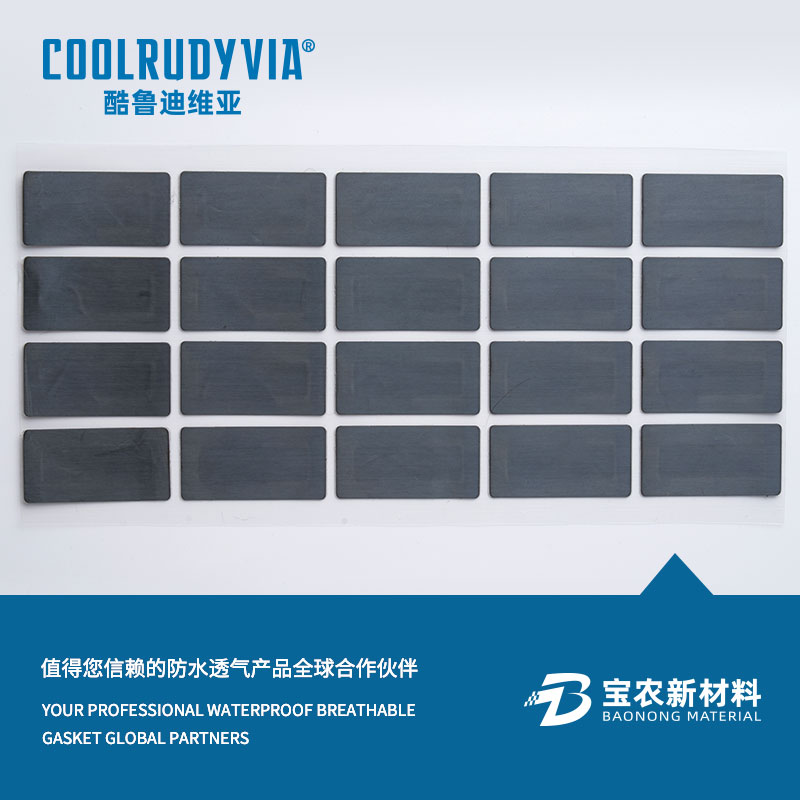
 Adhesive-Backed Waterproof Permeable Membrane for Car LampsAn easy-to-install breathable film that prevents condensation inside headlights and taillights. It adapts to different lamp geometries and is validated by multi-stage airflow testing, making it a reliable choice for lighting assemblies.View Product →
What a data sheet tells you
Nominal airflow, nominal water entry pressure, temperature range, and the material of the housing body.
What actually decides the outcome
Airflow distribution across the production lot, pull-out force consistency, membrane lot traceability, and how the joint behaves after 200 thermal cycles.
Sourcing ePTFE Vent Plugs as a Tier Supplier
Tier suppliers should screen for airflow consistency and membrane lot control first, and unit price last. A vent plug that costs a few cents less but varies by 30 percent in airflow will generate warranty claims that dwarf the saving.
Three supplier capabilities separate reliable programs from risky ones: process capability on airflow and pull-out force, traceability from membrane roll to finished plug, and the ability to supply membrane and housing as one validated assembly rather than two parts that each hold half the tolerance. Integrated manufacturing matters here, because the tolerance stack between a separately sourced membrane and a separately sourced body is where most vent failures begin.
Buyers also need a supplier who can document validation rather than merely promise it. Changzhou Baonong New Material Technology Co., Ltd., operating under the COOLRUDYVIA brand, builds ePTFE vent plugs, caps, and gaskets as an integrated manufacturer, with a workshop of more than 6,000 square meters, over 90 automated production units, and a dual inspection routine that pairs automated checking with manual review. A detailed walkthrough of membrane selection is available in this ePTFE vent plug selection guide.
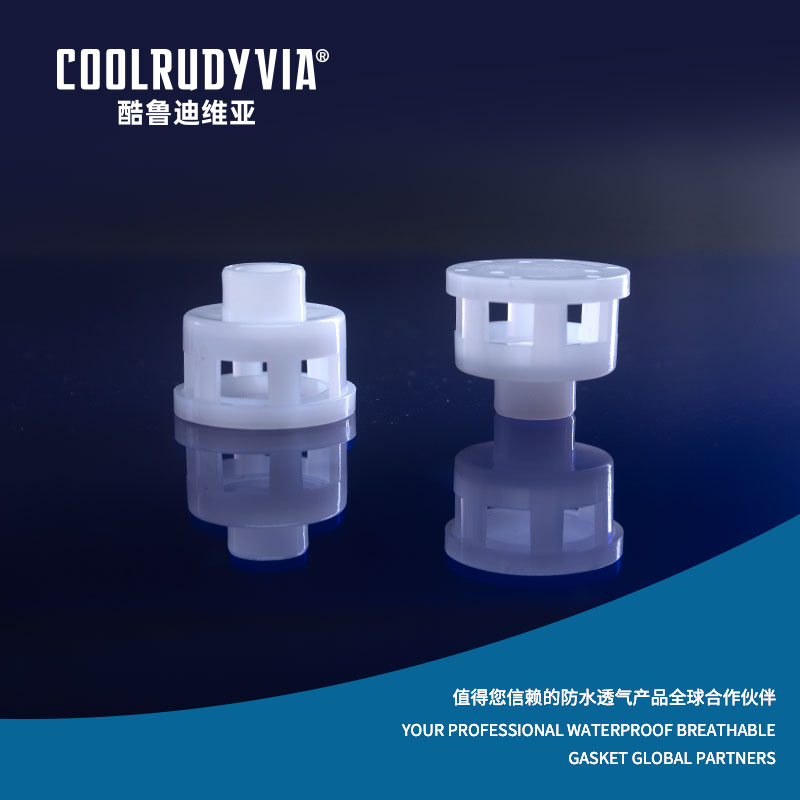 ePTFE Waterproof Breathable Plug with Pressure EqualizationA breathable plug that balances internal pressure while blocking water, oil, and dust. Built from microporous ePTFE, it achieves IP67/IP68 and supports IP69K when integrated and validated within the finished housing.View Product →
ePTFE Vent Plug Questions Automotive Buyers Ask Most
What IP rating can an ePTFE vent plug achieve?
A correctly designed and welded plug reaches IP67 and IP68 as standard, and IP69K when the housing, membrane support, and seal are validated for high-pressure hot water jet cleaning. The rating belongs to the finished assembly, not to the membrane alone.
Does the membrane let water vapor through?
Yes, and that is intentional. Water vapor molecules pass through the pores, so trapped moisture escapes instead of condensing on optics or electronics. Liquid water cannot follow the same path because surface tension holds it out at the rated water entry pressure.
What airflow should be specified for a headlamp or ECU?
Size the airflow to the enclosure volume and the fastest expected temperature change. Most headlamp and ECU programs land between 50 and 500 ml/min at 70 mbar for a 10 mm plug, and airflow must be verified after thermal cycling, not only on new parts.
Can one vent plug handle oil, fuel, and washer fluid?
Standard hydrophobic membranes handle water and dust well but degrade in contact with low-surface-tension fluids. Oleophobic treated grades hold water entry pressure above 1,500 mbar and resist oil mist, which is why they are specified for engine bay and powertrain locations.

-
Phone Number
+86 138 6105 7907
-
Address
No. 58 Fengjiatou, Xiaoliu Village, Luoyang Town, Wujin District, Changzhou, Jiangsu, China
Copyright © Changzhou Baonong New Material Technology Co., Ltd.All rights reserved
PrivacyCustom Waterproof Breathable Membranes/Gaskets/Plugs/Caps