
 English
 中文简体
 Español
 عربى

How to Specify Custom Waterproof and Breathable Plugs for Pressure Balance
 2026.10.01
 Industry News
Content
- 1 What a Custom Waterproof and Breathable Plug Actually Does
- 2 Why Custom Waterproof and Breathable Plugs Are Specified for Pressure Balance, Not Fit
- 3 Material Selection for Custom Waterproof and Breathable Plugs
- 4 How to Specify a Custom Waterproof and Breathable Plug on a Drawing
- 5 Field Failure Modes Custom Plugs Are Built to Prevent
- 6 How to Qualify a Supplier for Custom Waterproof and Breathable Plugs
- 7 Frequently Asked Questions
A rigid 500 mL bottle filled at 32 °C and moved into a 4 °C cooler develops around 0.10 bar of vacuum in its headspace. If the closure cannot relieve that differential, the container panels in, the liner cold-flows out of contact, or liquid migrates through the threads. The same physics applies to a sealed headlamp, a pole-mounted sensor housing, or a drum of crop protection product, and it is why engineering teams end up specifying custom waterproof and breathable plugs sized to a specific port instead of a catalog thread.
Most teams reach this component after a failure rather than before one. That changes the work: the task becomes defining an allowable pressure window, choosing a membrane that survives the chemistry it will meet, and selecting a housing that survives installation torque.
What a Custom Waterproof and Breathable Plug Actually Does
A custom waterproof and breathable plug is a vented closure built around an expanded polytetrafluoroethylene (ePTFE) membrane and dimensioned to fit one specific port, cap, or housing rather than a generic opening.
Definition: an ePTFE vent membrane is a microporous polymer sheet with pores typically measuring 0.1 to 1.0 micrometers. A water vapour molecule is roughly 0.0004 micrometers across, while the smallest wind-driven water droplets run about 20 micrometers. Gas and vapour move through the pore network; liquid water cannot establish a continuous path across it.
The membrane is the functional core, but it is never fitted alone. It sits inside a housing that decides how the plug installs, how much torque it survives, and how long it lasts. Waterproof and breathable plugs from Changzhou Baonong New Material Technology Co., Ltd. ship as an integrated unit, with housings produced in aluminium alloy, stainless steel, or engineering plastic depending on the application.
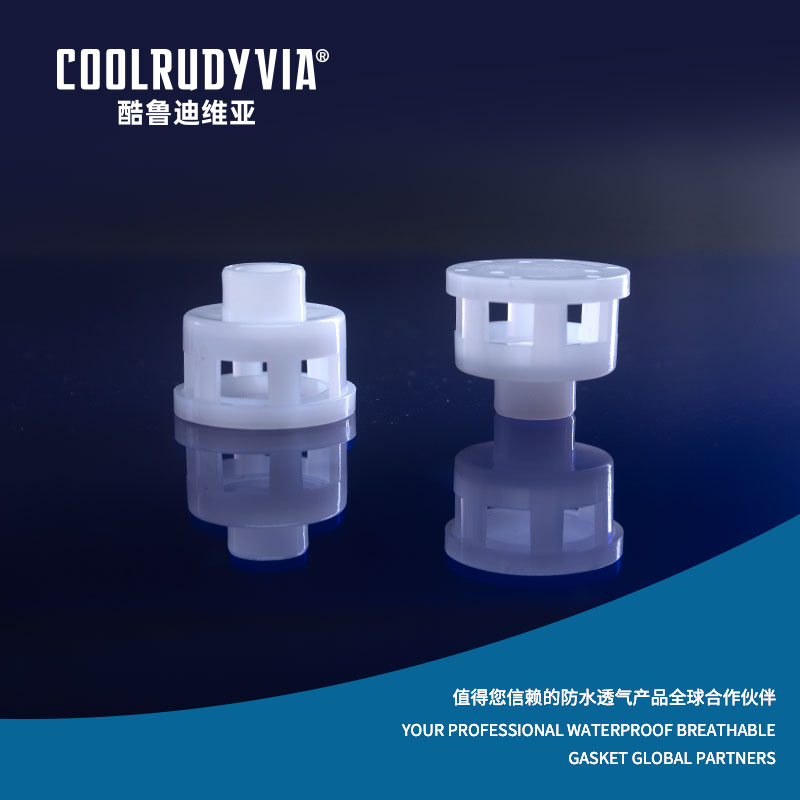 Integrated Waterproof Breathable Vent Plug with ePTFE MembraneA ready-to-install plug combining a microporous ePTFE membrane with an aluminum, stainless steel, or plastic housing, designed to equalize pressure while blocking water and dust ingress.View Product →
In service the plug does three jobs at once: it equalizes pressure across the barrier, blocks liquid water and particulate ingress, and lets internal condensation escape as vapour rather than pooling against electronics. The pore-level mechanics are covered in this explanation of how a waterproof breathable plug blocks water but not air.
The size gap between a membrane pore and the smallest wind-driven droplet is the entire mechanism. There is no valve, no moving part, and nothing that can fail to reseat.
Why Custom Waterproof and Breathable Plugs Are Specified for Pressure Balance, Not Fit
Customization is driven by airflow and chemistry requirements far more often than by thread dimensions. The thread is usually the easy part.
When a project moves from a standard vent plug to a custom one, the trigger is almost always one of five things:
- Airflow that must match container volume and thermal cycling rate, not simply be sufficient
- Contact with agrochemical actives, solvents, or essential oils that attack a standard hydrophobic membrane
- Oleophobic treatment required because the environment carries oil mist, surfactants, or washdown chemicals
- An installation method a standard housing cannot serve, such as press-fit, snap-fit, or induction-sealed foil
- Colour, laser marking, or lot traceability tied to a production line or a customer specification
A buying team that asks only for a thread size receives a part that installs but may not vent at the required rate. Ask instead for the airflow figure at a stated differential, and the supplier has something measurable to design against.
Material Selection for Custom Waterproof and Breathable Plugs
Housing material sets corrosion life, torque tolerance, and unit cost. The membrane grade is usually shared across all three options, so the material is where most of the cost difference sits.
| Housing material | Typical mounting | Corrosion behaviour | Relative unit cost | Where it wins |
| Aluminium alloy | Threaded or press-fit | Bare surface oxidizes; anodizing improves durability | Medium | Outdoor electronics, lighting, weight-sensitive housings |
| Stainless steel 304 / 316 | Threaded, press-fit, welded | High resistance to chlorides and washdown chemistry | High | Food processing, marine, chemical splash zones |
| Engineering plastic | Snap-fit, ultrasonic weld, press-fit | No galvanic corrosion, but UV and temperature limited | Low | Beverage closures, single-use packaging, high-volume parts |
Aluminium alloy is the default for outdoor electronic housings because it threads cleanly, weighs little, and anodizes to a predictable finish. Stainless steel takes over where chlorides or aggressive washdown chemistry are present, at a meaningful unit-cost premium.
 Custom Aluminum Alloy Breather Vent Plug for Outdoor HousingsThreaded aluminum plug option that balances light weight and anodized finish for outdoor electronics, with stainless steel available where chlorides or harsh washdowns are a concern.View Product →
How to Specify a Custom Waterproof and Breathable Plug on a Drawing
A complete specification needs six numbers, and leaving any one of them out shifts the risk onto the supplier's assumptions.
- Airflow at a stated differential, usually quoted at 70 mbar.
- Ingress rating with the test condition named: IP67, IP68, or IP69K.
- Temperature range covering transport and storage, not only operation.
- Contact chemistry: the contents, the cleaning agents, and any oil mist.
- Installation method and the allowable torque window.
- Colour, marking, and lot traceability requirements.
Airflow is the number most often under-specified, and it decides whether the membrane is a standard hydrophobic grade or an oleophobic variant. The chart below shows how membrane structure changes delivered airflow at a fixed differential.
Airflow index by membrane structure at 70 mbar
Higher airflow is not automatically better. A membrane that moves air quickly also passes vapour quickly, which matters when the enclosure holds something that must not dry out or take on ambient moisture during storage.
Standard Hydrophobic ePTFE
- Higher delivered airflow at the same pore size
- Lower unit cost and widely stocked grades
- Pores can be wetted by low-surface-tension liquids
Oleophobic ePTFE
- Resists oil mist, surfactants, and cleaning agents
- Keeps airflow stable over a longer service life
- Higher unit cost and lower delivered airflow
Field Failure Modes Custom Plugs Are Built to Prevent
Four failure modes account for most field returns on vented enclosures, and each one maps to a specific design decision rather than a general quality complaint.
- Condensation accumulation. A sealed housing that cools overnight draws humid air in through any path it finds. Without a vent, that moisture collects on the coldest surface, usually a circuit board or an optical element.
- Surfactant wetting. Detergents, agrochemical adjuvants, and cutting fluids lower the surface tension of water enough to push it through a hydrophobic membrane. The pore network fills and airflow stops permanently.
- Over-torque damage. Plastic housings deform past their specified torque, the sealing face loses contact, and the enclosure leaks at the thread rather than at the membrane.
- Salt spray and UV ageing. Unanodized aluminium pits in chloride environments and unprotected plastic embrittles under sustained UV, shortening service life in outdoor installations.
 Vent Cap for Automotive Lamp and Headlamp HousingsA protective cap that shields the breathable membrane from dust, mud, and water spray, sized to automotive port requirements and built for long-term thermal cycling and road exposure.View Product →
Automotive headlamp and lighting housings combine three of these risks at once: wide thermal cycling, road spray carrying dissolved salts, and a service life measured in years. Vented caps sized to the housing port address all three, which is why the automotive vent family exists as a separate product line rather than a generic plug.
How to Qualify a Supplier for Custom Waterproof and Breathable Plugs
Supplier qualification for vented components reduces to four verifiable items.
- Membrane traceability, including lot number, pore size, and whether the grade is hydrophobic or oleophobic, backed by an airflow certificate.
- In-line leak testing during production, not only laboratory sampling at the start of a project.
- Sample-to-production consistency, meaning the same automated equipment and tooling run both the sample and the volume order.
- Documented IP testing to a named standard and test condition, available on request rather than promised verbally.
The underlying question is whether the supplier controls the membrane and the housing as one process or assembles them from separate vendors. A manufacturer running membrane converting, housing production, and inspection inside one facility can hold tolerances a trading operation cannot, and can trace a field failure back to a specific production lot.
The fastest way to qualify a vent plug supplier is to ask for the airflow curve for the exact membrane grade being quoted, not the grade above it.
Frequently Asked Questions
How long does a custom waterproof and breathable plug take to produce?
Allow four to eight weeks for a new housing combined with an existing membrane grade, covering tooling, samples, and approval. A new membrane grade or new tooling adds time. The bottleneck is almost always validation, not production.
Can one vent plug meet both IP68 and IP69K?
Yes. The two tests measure different things. IP68 covers continuous immersion, while IP69K covers close-range high-pressure high-temperature spray. Metal-housed vent plugs commonly hold both; the deciding factor is the seal around the membrane, not the membrane itself.
When is an oleophobic membrane necessary?
Whenever oil mist, surfactants, cleaning agents, or agrochemical adjuvants are present. A standard hydrophobic ePTFE membrane can be wetted by low-surface-tension liquids. Once a liquid film bridges the pores, airflow stops and the blockage is permanent.
Do custom waterproof and breathable plugs require a new mould?
Only when the housing geometry is genuinely new. If the specification fits an existing thread size such as M5 or M12, existing tooling usually applies, and the customization sits in the membrane grade, airflow target, colour, and marking.
The trigger for a custom waterproof and breathable plug is almost never the thread. It is a pressure differential a static seal cannot absorb, a chemical environment a standard membrane cannot survive, or a service life an unprotected housing cannot reach. Define those three things before the drawing is issued and the rest of the specification follows.

-
Phone Number
+86 138 6105 7907
-
Address
No. 58 Fengjiatou, Xiaoliu Village, Luoyang Town, Wujin District, Changzhou, Jiangsu, China
Copyright © Changzhou Baonong New Material Technology Co., Ltd.All rights reserved
PrivacyCustom Waterproof Breathable Membranes/Gaskets/Plugs/Caps