
 English
 中文简体
 Español
 عربى

Custom Waterproof and Breathable Vent Plug: Selection and Specification Guide
 2026.10.15
 Industry News
Content
- 1 What a Custom Waterproof and Breathable Vent Plug Actually Does
- 2 Pressure, Not Water, Is What Breaks Sealed Enclosures First
- 3 Choosing the Body Material: Aluminum Alloy, Stainless Steel, or Plastic
- 4 Five Parameters That Belong on a Custom Waterproof and Breathable Vent Plug Drawing
- 5 Where a Custom Vent Plug Changes the Result
- 6 What to Verify Before You Approve a Supplier
- 7 Frequently Asked Questions
A 500 mL rigid bottle capped at 20 degrees Celsius and then heated to 65 degrees Celsius inside a shipping container builds roughly 173 mbar of internal pressure. That is enough to dome a thin PET base, lift an induction seal, or push liquid past a cap liner that passed every static leak test in the laboratory. When engineers in automotive lighting, pesticide packaging, and outdoor electronics start sourcing a custom waterproof and breathable vent plug, this pressure figure, not the water ingress rating, is usually what pushed them there.
A distributor's stock vent plug is engineered around an average enclosure: moderate internal volume, moderate temperature swing, and a mounting hole the designer is expected to adapt. Once the real numbers arrive, the average part either chokes the airflow or stops sealing, and the project moves to a specified component.
What a Custom Waterproof and Breathable Vent Plug Actually Does
A custom waterproof and breathable vent plug is an assembled pressure-equalisation component built around an expanded PTFE (ePTFE) membrane: gas moves through sub-micron pores while liquid water, dust, and most contaminants stay outside the housing.
The membrane alone does not make a working vent. Three decisions have to line up before the part performs in a real enclosure:
- Membrane grade, where pore size and wall thickness set the trade-off between airflow and water entry pressure.
- Body material and geometry, chosen from aluminum alloy, stainless steel, or engineering plastic in the thread, barb, or snap-fit form the assembly needs.
- Sealing interface, the O-ring, gasket, or ultrasonic weld that stops water travelling around the membrane instead of through it.
A waterproof and breathable vent plug is a pressure valve with no moving parts. Its ePTFE membrane carries billions of pores per square centimetre, each far smaller than a water droplet, so air and water vapour diffuse through the wall while liquid stays outside.
In practice the surrounding structure sets the real limit, not the membrane. A plug with a perfect membrane and a marginal O-ring groove leaks at the groove. That is why custom work starts with the mounting interface, then works back to airflow and ingress targets.
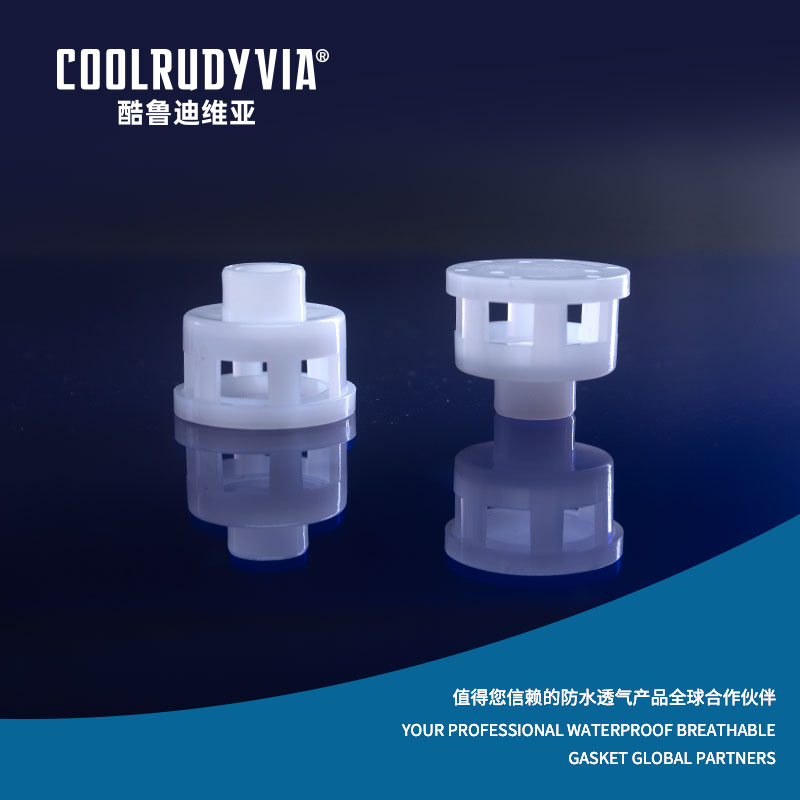 ePTFE Waterproof Breathable Plug for Pressure EqualizationePTFE microporous membrane equalizes pressure in sealed enclosures while blocking water, oil, and dust; mounting interface and pressure loads shape selection.View Product →
Pressure, Not Water, Is What Breaks Sealed Enclosures First
Most field failures on sealed packages are pressure failures, and they show up long before any water reaches the membrane. A rigid enclosure with fixed internal volume follows the ideal gas law: raise the temperature by 50 degrees Celsius and absolute internal pressure climbs about 17 percent.
Convert that into mechanical load and the numbers get uncomfortable. A 63 mm cap with an effective sealing area near 2,800 square millimetres carries roughly 48 N of lifting force at 173 mbar. That load lifts induction seals, stresses weld seams, and pushes viscous fill media past a liner that was never designed to resist it.
Airflow is always quoted against a reference pressure drop, commonly 70 mbar, which is close to 1 kPa. A part rated at 200 mL per minute suits a small sensor housing. A 5 litre container stored in a hot warehouse needs several litres per minute, and the difference between those two parts is invisible on a datasheet that lists only an IP rating.
- Internal pressure tracks temperature with no relief path
- Seals and welds carry the full pressure load
- Condensation forms on any surface below dew point
- Fill media can seep past the liner in transit
- Pressure equalises in seconds at typical airflow rates
- Seals carry assembly load only, not pressure load
- Water vapour migrates out, cutting condensation
- Dust and liquid stay outside the membrane
The underlying physics is straightforward, and it is worth reading how a waterproof breathable plug blocks water but not air before locking a specification, because the mechanism decides which of your numbers matter most.
Choosing the Body Material: Aluminum Alloy, Stainless Steel, or Plastic
Choose the body material by the environment the plug will live in, not by unit price. The membrane is usually identical across the three families; the housing is what fails first.
| Material | Best environment | Corrosion resistance | Weight and cost | Typical mounting |
| Aluminum alloy | Automotive housings and outdoor electronic enclosures | Anodised surface handles humidity, less suited to direct salt spray | Light, low to medium cost | Threaded or press-fit |
| Stainless steel 304 or 316 | Chemical, pesticide, and food-adjacent packaging | Highest, with 316 tolerating chlorides | Heaviest, highest cost | Threaded, welded, or crimped |
| Engineering plastic | Beverage caps, consumer packaging, light enclosures | No metal corrosion, but UV and fill chemistry still apply | Lightest, lowest cost | Snap-fit, ultrasonic weld, insert moulding |
One practical rule from production floors: if the plug sits within 100 mm of a heated lamp assembly, specify metal. If it sits in a bottle cap that is torqued by a high-speed capper, plastic usually wins on cost and on the risk of cross-threading.
 Custom Aluminum Alloy Breather Vent Plug for Outdoor ElectronicsAluminum alloy and ePTFE membrane equalize pressure in sealed outdoor electronics, automotive lighting, and telecom enclosures; consider metal near heated lamp assemblies.View Product →
Five Parameters That Belong on a Custom Waterproof and Breathable Vent Plug Drawing
A vent plug specification is complete only when five numbers are written down and testable. Everything else can be negotiated during sampling.
- Airflow at a stated pressure drop. Ask for millilitres per minute at 70 mbar or 1 kPa, plus the test method used, so two suppliers quote the same quantity.
- Water entry pressure and target ingress rating. IP68 needs a depth and duration; IP69K needs a washdown temperature and pressure. Both are meaningless without that context.
- Mounting geometry and torque window. Thread size, O-ring groove dimensions, wall thickness, and the maximum tightening torque, because over-torquing deforms the membrane seat and silently increases water entry pressure.
- Media and peak temperature exposure. The fill chemistry, cleaning agents, and any process peak such as a retort cycle, paint bake, or wash tunnel will decide the body material faster than the operating temperature does.
- Traceability and validation evidence. Dimensional reports, airflow data per lot, material certificates, and the vendor's ability to run the specific automotive or packaging standard your end customer requires.
Where a Custom Vent Plug Changes the Result
Three application families account for most custom vent plug projects: automotive lighting and component packaging, liquid and solid packaging, and outdoor electronics. Each one is dominated by a different failure mode.
Automotive work is driven by thermal cycling. A headlamp that runs hot and then cools in rain swings through tens of degrees in minutes, so fogging and seal stress are the visible symptoms. A dedicated vent cap equalises that swing without letting water past the membrane, which is why automotive vent caps are specified as a sealed, tested assembly rather than a simple hole and membrane.
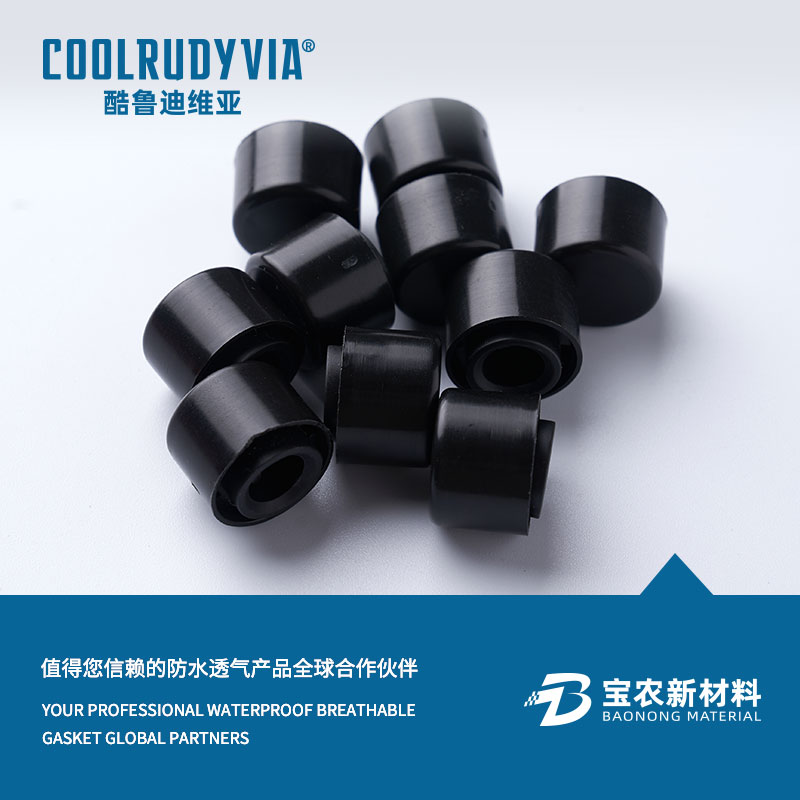 Custom Waterproof Breathable Vent Cap for Automotive LampsWaterproof breathable vent cap for automotive lamps balances thermal pressure swings, reducing fogging and water ingress while protecting LED electronics.View Product →
Packaging work is driven by transport. Bottles filled warm, stacked in a container, and moved across an altitude change will bulge, dent, or leak unless the closure vents. Beverage and pesticide containers see the same physics with different chemistry, and the fill medium decides whether a plastic, stainless steel, or coated body survives. Where the sealing surface is flat rather than threaded, a waterproof breathable gasket delivers the same pressure relief in a lower profile.
Outdoor electronic work is driven by condensation. A sealed housing that cools overnight pulls its internal atmosphere below dew point, and droplets land on boards and connectors. A vent plug with the right airflow dries the enclosure passively, and the aluminum alloy, plastic, and stainless steel options cover the installation environments that outdoor equipment actually faces.
What to Verify Before You Approve a Supplier
Verify the manufacturing chain, not the datasheet. A vent plug is a functional component, and the difference between compliant and non-compliant lots usually appears in assembly consistency.
- Integrated manufacturing, where membrane, gasket, plug, and cap are produced and assembled under one quality system rather than sourced from four vendors.
- Automated inspection plus manual verification on every batch, since airflow testing catches what a visual check cannot.
- In-house tooling and assembly equipment, which shortens the loop between a drawing change and a revised sample.
- Compliance testing capability for automotive and packaging standards, agreed before the first production order.
Changzhou Baonong New Material Technology Co., Ltd. operates under the COOLRUDYVIA brand from Changzhou, Jiangsu, running more than 6,000 square metres of standard workshop space and over 90 automated units across membrane, gasket, and vent plug production. For buyers, the relevant question is not the size of the floor, but whether the same line that produced the sample will produce the shipment.
Frequently Asked Questions
How do I size the airflow rating for a custom vent plug?
Estimate the pressure your enclosure generates at its worst temperature and altitude condition, then choose a plug whose rated airflow at 70 mbar moves that volume of air in under a minute. Small sensor housings are usually served by 200 to 500 mL per minute, while multi-litre containers and equipment cabinets often need several litres per minute.
Can a vent plug be added after the enclosure is already in production?
Yes, in most cases. Retrofits are common where a sealed housing has started to bulge or fog in the field, and a threaded or press-fit vent plug can often use an existing boss or a simple drilled port. The constraint is wall thickness and the sealing surface around the new port, not the vent itself.
What ingress rating should I specify?
Specify the test, not just the number. IP68 without a depth and duration is not a specification. For washdown environments, IP69K adds a high-pressure, high-temperature jet requirement that changes both the O-ring and the body material selection.
Does a vent plug release water vapour as well as air?
Yes, and that is half of its value. The same membrane pores that equalise pressure allow water vapour to migrate out of the enclosure, which reduces condensation on cold surfaces and lowers the risk of corrosion on electronics and internal coatings.
Start the specification with the pressure number your product generates in its worst shipping or operating condition, then work outward to membrane, body material, and mounting. That order keeps the conversation about performance instead of unit price, and it usually cuts the number of sample iterations in half.

-
Phone Number
+86 138 6105 7907
-
Address
No. 58 Fengjiatou, Xiaoliu Village, Luoyang Town, Wujin District, Changzhou, Jiangsu, China
Copyright © Changzhou Baonong New Material Technology Co., Ltd.All rights reserved
PrivacyCustom Waterproof Breathable Membranes/Gaskets/Plugs/Caps