
 English
 中文简体
中文简体 Español
 عربى
عربى
What is the Working Principle of a Waterproof Breathable Plug Based on ePTFE Membrane?
 2026.01.08
 Industry News
Content
- 1 Introduction: Solving the Pressure Paradox in Sealed Enclosures
- 2 Part 1: The Core Engineering Challenge and the ePTFE Solution
- 3 Part 2: Material Science Foundation: The Architecture of ePTFE
- 4 Part 3: The Physics of Selective Permeability
- 5 Part 4: From Membrane to Engineered Component
- 6 Part 5: Specification and Selection for Design Engineers
- 7 Conclusion: A Symphony of Physics and Materials Engineering
- 8 Frequently Asked Questions (FAQs)
- 8.1 1. Can an ePTFE plug prevent condensation inside an enclosure?
- 8.2 2. How does the plug maintain its waterproofness if the pores are open to air?
- 8.3 3. What happens if the ePTFE membrane gets dirty or oily? Does it clog?
- 8.4 4. Is there a trade-off between higher waterproof rating (IP68) and breathability?
- 8.5 5. How long do these plugs last, and do they require maintenance?
Introduction: Solving the Pressure Paradox in Sealed Enclosures
Modern electronic and electromechanical systems, from automotive sensors to outdoor LED luminaires, demand robust environmental sealing. However, a hermetic seal creates a fundamental engineering conflict: internal pressure differentials caused by temperature cycling, altitude changes, or manufacturing processes can stress housings, compromise seals, or lead to damaging condensation. The waterproof breathable plug is the engineered solution to this paradox. This technical analysis delves into the working principle of the most advanced variant, one based on expanded Polytetrafluoroethylene membrane, explaining how its microporous architecture enables selective permeability—allowing air to pass while definitively blocking liquids and contaminants—and its critical role in ensuring product reliability and longevity.
Part 1: The Core Engineering Challenge and the ePTFE Solution
Sealed enclosures are prone to pressure build-up or vacuum formation. Without relief, this can cause gasket failure, housing distortion, or moisture ingress through microscopic paths during equalization. Traditional vent holes allow pressure equalization but admit water, dust, and corrosive agents. Permanent seals avoid contamination but lock in pressure stress. The ePTFE waterproof breathable plug for pressure equalization resolves this by acting as a one-way barrier for pressure, allowing gases to diffuse freely while presenting an insurmountable barrier to liquids, thanks to the unique properties of expanded Polytetrafluoroethylene (ePTFE).
Part 2: Material Science Foundation: The Architecture of ePTFE
Understanding the function begins with the material. Polytetrafluoroethylene (PTFE) is a highly inert, hydrophobic fluoropolymer. ePTFE is created by mechanically expanding PTFE in a controlled process, transforming a solid polymer into a microporous matrix.
2.1 Microstructure Creation: The Node-and-Fibril Network
The expansion process creates a structure of solid polymer "nodes" interconnected by countless "fibrils." This forms a labyrinthine network of microscopic pores. The critical engineering parameters are:
- Pore Size: Typically ranging from 0.1 to 3.0 microns, smaller than a water droplet but larger than gas molecules.
- Porosity: The percentage of the membrane volume that is void space, often exceeding 70%.
- Hydrophobicity: Inherited from PTFE, ePTFE has an extremely low surface energy, causing water to bead up with a high contact angle (>110°).
This combination of fine, interconnected pores and innate water-repellency is the physical foundation for the plug's dual function.
Part 3: The Physics of Selective Permeability
3.1 The Breathability Mechanism: Gas Diffusion
Gas molecules (N₂, O₂) are several orders of magnitude smaller than the pores in the ePTFE membrane. When a pressure differential exists across the membrane—for instance, higher pressure inside a warming electronic enclosure—gas molecules flow through the tortuous pore paths via diffusion. This process of ePTFE waterproof breathable plug for pressure equalization is rapid, often occurring in milliseconds to seconds, effectively preventing any significant mechanical stress on the housing. The rate of gas flow is quantified as the membrane's air flow rate or permeability, a key specification for designers.
3.2 The Waterproofing Mechanism: Capillary Force and Hydrostatic Pressure
Liquid water, due to its high surface tension, cannot spontaneously enter the hydrophobic micro-pores. The meniscus formed at the pore entry creates a capillary back-pressure. The membrane will only allow water penetration when the external hydrostatic pressure exceeds this critical "bubble point" pressure of the membrane. This principle allows a plug to be engineered for a specific IP68 rated waterproof breathable vent plug application, where it must withstand prolonged immersion at defined depths without leakage. The waterproof performance is thus an intrinsic, material-based property, not reliant on mechanical valves that can fail.
3.3 Performance Comparison: ePTFE vs. Alternative Venting Methods
The superiority of ePTFE-based solutions becomes clear when compared to common alternatives.
| Venting Method / Material | Breathability (Gas Flow) | Water Ingress Protection | Long-Term Reliability in Harsh Environments | Typical Application Suitability |
|---|---|---|---|---|
| Simple Hole / Mesh | Excellent | None | Poor (clogs easily, no liquid barrier) | Benign, dry indoor environments only. |
| Foam or Felt Pad | Good (when dry) | Limited (absorbs water, then fails) | Poor (saturates, breeds microbes, degrades) | Low-cost, non-critical applications with minimal liquid exposure. |
| Sintered Plastic or Metal | Moderate to Low (dense structure) | Good (if pore size is very small) | Good, but pores can become permanently clogged by particulates. | Applications where contamination is minimal and low airflow is acceptable. |
| ePTFE Membrane (Hydrophobic) | Excellent (high porosity) | Excellent (hydrostatic barrier) | Outstanding (inert, hydrophobic, cleanable surface) | Demanding applications: automotive sensor housing, outdoor electronics, medical devices, etc. |
Part 4: From Membrane to Engineered Component
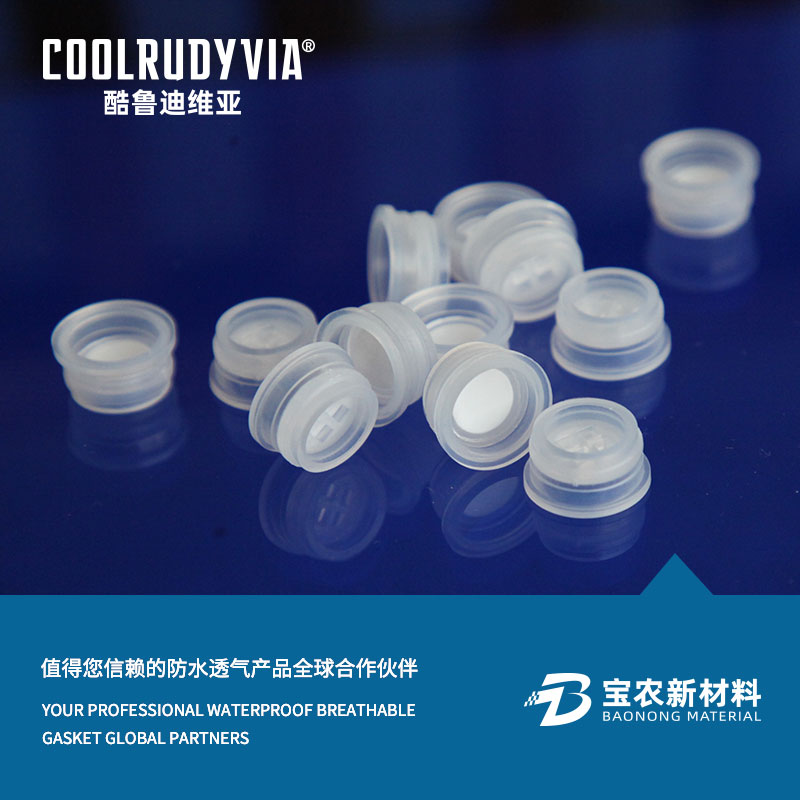
A raw ePTFE membrane must be integrated into a robust component to be usable. A typical waterproof breathable plug consists of the ePTFE membrane, a supportive and often rigid housing (made from compatible plastics or metal), and a sealing element (like an O-ring or pressure-sensitive adhesive).
4.1 Designing for Application-Specific Requirements
The component design is dictated by the installation environment. For a custom shape waterproof breathable membrane plug, the housing is molded to fit unique contours or mounting points. The choice of membrane grade (pore size, thickness) is balanced to achieve the required airflow while meeting the target hydrostatic pressure rating. This customization is critical for complex applications like a waterproof breathable plug for automotive sensor housing, which must survive thermal shock, fuel/oil exposure, high-pressure washdowns, and vibration.
4.2 Validating Performance: The Testing Regime
Understanding how to test waterproof breathable plug performance is essential for qualification. Key tests include:
- Air Flow Rate Test: Measures the volumetric flow of air through the plug under a standard pressure differential (e.g., 1 psi).
- Hydrostatic Pressure Test (Bubble Point): Determines the pressure at which water first penetrates the membrane, verifying its waterproof capability.
- IP Rating Immersion Test: Validates the entire assembled plug's ability to prevent water ingress when subjected to the conditions of standards like IEC 60529 (e.g., 1 meter immersion for 30 minutes for IPX7).
- Environmental Durability Testing: Exposes the plug to temperature cycles, UV radiation, salt spray, and chemical exposure to simulate years of service life.
The global push for greater sustainability and material transparency is influencing component standards. According to the latest technical review by the International Electrotechnical Commission, future amendments to material standards for electronic enclosures are likely to incorporate stricter guidelines on the long-term environmental impact and chemical compliance of polymeric components, including membranes and housing materials. This aligns with broader industry trends like the EU's REACH regulation, making a manufacturer's expertise in material selection and compliance documentation increasingly valuable.
Part 5: Specification and Selection for Design Engineers
Selecting the correct plug is a systematic process. The designer must:
- Determine the maximum required air flow rate based on the enclosure's internal volume and the worst-case rate of temperature or pressure change.
- Define the waterproof requirement based on the application's exposure (e.g., occasional splash, driving rain, temporary immersion) and translate this into a target hydrostatic pressure rating or IP code.
- Define the chemical, temperature, and UV exposure profile to ensure material compatibility.
- Determine the mounting configuration (threaded, snap-in, adhesive) and available space, which may necessitate a custom shape solution.
A partner with deep materials engineering expertise is crucial in this phase. A manufacturer grounded in precision polymer processing and assembly can bridge the gap between a theoretical ePTFE membrane property and a reliable, production-ready component. Their technical team can guide the selection of the optimal membrane grade, design a housing that protects the membrane from mechanical damage and clogging, and ensure the sealing method is robust for the intended lifespan. This vertical integration from material science to finished, tested part is what transforms a clever concept into a dependable solution for a critical waterproof breathable plug for automotive sensor housing or any other high-reliability application.
Conclusion: A Symphony of Physics and Materials Engineering
The waterproof breathable plug based on ePTFE membrane is a masterful application of materials science. It exploits the fundamental differences in the physical behavior of gases and liquids at the microscopic scale. By leveraging the innate hydrophobicity and controlled porosity of ePTFE, it provides a passive, reliable, and maintenance-free solution to the enduring challenge of pressure management in sealed systems. For design engineers, understanding this principle is the key to specifying a component that safeguards product integrity, ensures performance, and extends service life in the most demanding environments.
Frequently Asked Questions (FAQs)
1. Can an ePTFE plug prevent condensation inside an enclosure?
Yes, it is one of its primary functions. Condensation occurs when warm, moist air inside an enclosure cools below its dew point. An ePTFE plug allows this moist air to slowly equalize with the (often drier) external atmosphere, reducing the humidity level inside and preventing the conditions that lead to condensation. For this to be effective, the plug must be installed while the internal air is relatively dry, such as during final assembly in a controlled environment.
2. How does the plug maintain its waterproofness if the pores are open to air?
Waterproofness is maintained by the combination of extremely small pores and the powerful hydrophobic (water-repelling) property of the ePTFE material. Water molecules are cohesive and have high surface tension. To enter a hydrophobic pore, water must overcome a significant energy barrier, reforming its surface into a shape that can enter the tiny opening. This only happens under substantial external pressure, which defines the plug's hydrostatic rating. Air molecules, being individual and non-cohesive, experience no such barrier and diffuse through easily.
3. What happens if the ePTFE membrane gets dirty or oily? Does it clog?
The hydrophobic nature of ePTFE provides oleophobic (oil-repelling) properties to a degree, but performance can be degraded by heavy contamination. For applications exposed to oils or particulate-laden environments (like an engine bay), the plug design often includes a protective outer membrane or sintered filter that blocks contaminants from reaching the ePTFE membrane while still allowing air flow. This is a critical design consideration for a waterproof breathable plug for automotive sensor housing.
4. Is there a trade-off between higher waterproof rating (IP68) and breathability?
Generally, yes. To achieve a higher hydrostatic pressure rating (e.g., for a 1-meter vs. a 3-meter immersion depth), the membrane often requires smaller pore sizes or additional layers. Smaller pores increase the resistance to gas flow, reducing the breathability (airflow rate). A skilled manufacturer can optimize the membrane structure to balance both properties for a specific application, but the inverse relationship is a fundamental aspect of the technology.
5. How long do these plugs last, and do they require maintenance?
Properly specified ePTFE plugs are designed to last the lifetime of the host product with zero maintenance. The PTFE polymer is chemically inert and highly stable against thermal and UV degradation. Failure modes are typically related to physical damage to the membrane, degradation of the housing or sealant material, or clogging from external contaminants in unprotected designs. When performance validation through tests like how to test waterproof breathable plug performance is conducted during design, it includes accelerated aging to predict this lifespan.

-
Phone Number
+86 138 6105 7907
-
Address
No. 58 Fengjiatou, Xiaoliu Village, Luoyang Town, Wujin District, Changzhou, Jiangsu, China
Copyright © Changzhou Baonong New Material Technology Co., Ltd.All rights reserved
PrivacyCustom Waterproof Breathable Membranes/Gaskets/Plugs/Caps