
 English
 中文简体
 Español
 عربى

Aluminum Foil Breathable Gaskets Company: Selection, Testing and Supply
 2026.09.23
 Industry News
Content
- 1 What an Aluminum Foil Breathable Gaskets Company Actually Delivers
- 2 How Aluminum Foil Breathable Gaskets Balance Pressure Without Leaking
- 3 How to Audit an Aluminum Foil Breathable Gaskets Company Before You Order
- 4 Liquid and Solid Packaging: Where a Breathable Gasket Pays for Itself
- 5 Automotive and Outdoor Electronics: Higher Pressure, Higher Stakes
- 6 Frequently Asked Questions
Specifying a breathable gasket is a pressure-balance decision, not an accessory decision. Choose the wrong airflow window and nothing fails on the filling line. The failure appears eight to twelve weeks later as a bulged PET bottle, a fogged headlamp lens, a swollen agrochemical container, or a sensor housing that has quietly taken on water. Buyers who treat an aluminum foil breathable gaskets company as a commodity die-cutter usually meet that gap during the first seasonal temperature swing, when the internal pressure of a sealed container shifts by 200 to 400 mbar and the closure has nowhere to relieve it.
What an Aluminum Foil Breathable Gaskets Company Actually Delivers
A capable aluminum foil breathable gaskets company delivers a laminated, die-cut closure component with a controlled vent path. It does not sell you a roll of membrane, and it is not a foil liner with a hole punched through it.
The commercial value sits in four stacked layers and the tolerance control that holds them together. Two suppliers can quote the same 38 mm disc and still ship different products, because the difference lives in coat weight, laminate bond, and die-cut concentricity rather than in the visible dimensions.
- Heat-seal adhesive layer, whose coat weight sets the sealing window on induction or conduction equipment.
- Aluminum foil barrier layer, typically 20 to 40 microns, which limits moisture vapor and oxygen migration.
- Microporous ePTFE membrane, the only functional layer for pressure equalization.
- Carrier and release liner, which protects the adhesive until the capping head fires.
Bond strength between foil and membrane decides whether the gasket survives a 40 degree container on a dock in July. Die-cut concentricity decides whether the vent area stays clear after the cap is torqued down. Ask for the layer drawing, the coat weight specification, and peel data, not only a price per thousand.
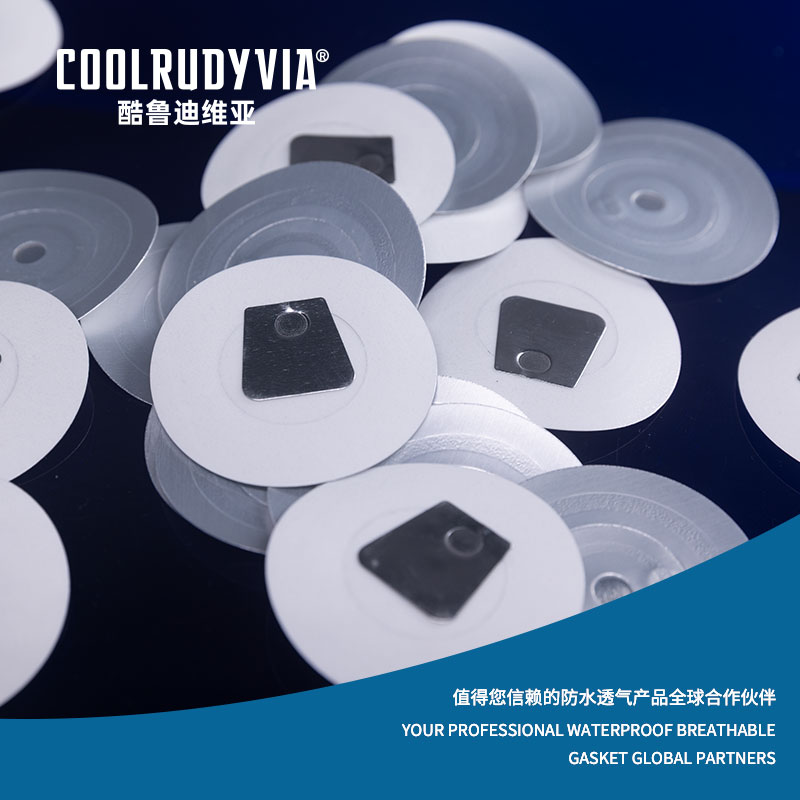 Aluminum Foil Induction Sealing Gasket for Container ClosuresInspect bond strength, die-cut concentricity, and peel data before choosing this induction sealing liner. Its ePTFE-free aluminum barrier blocks vapor, aroma, and oxygen for tamper-evident sealing.View Product →
How Aluminum Foil Breathable Gaskets Balance Pressure Without Leaking
A breathable foil gasket equalizes pressure through a microporous ePTFE membrane whose pores measure 0.1 to 10 microns, roughly four orders of magnitude smaller than a water droplet, while the aluminum layer blocks vapor, aroma, and oxygen.
The physics is simple enough to check on the back of an envelope. A rigid container sealed at 25 C and stored at 55 C develops an internal pressure rise of several hundred millibars. Without a vent, that load transfers into the cap, the thread, and the container wall. With a vent, the membrane passes air at a rate set by its active area and pore structure, so the differential never accumulates.
That spread is the whole reason to specify instead of defaulting. A 40 ml band relieves a bottle headspace over hours, which is right for a carbonated or aromatic product. A 680 ml band relieves an enclosure in seconds, which is right for a sealed electronics housing that heats and cools quickly.
Water entry pressure has to match the application rather than the datasheet ceiling. That band covers spray cleaning and pallet vibration but not steam sterilization. If your process runs a tunnel pasteurizer or an autoclave, the vent construction changes, and the change has to happen before tooling, not after. For a deeper breakdown of membrane physics and laminated construction, see how aluminum foil breathable gaskets work and where they are used.
How to Audit an Aluminum Foil Breathable Gaskets Company Before You Order
Audit five documents before placing a first order: batch airflow data, peel strength after heat aging, the sealing window, water entry pressure, and a dimensioned die-cut drawing. A supplier that cannot produce those on request is trading membrane, not manufacturing gaskets.
| Verification item | What to request | Failure it prevents |
| Airflow consistency | Lot airflow data at 10 kPa across at least three production runs | Under-venting, bulged containers, panel distortion |
| Laminate bond | Peel strength before and after 72 hours at 60 C | Delamination during transit or high-temperature storage |
| Sealing window | Adhesive coat weight plus recommended temperature and dwell band | Channel leaks and weak seals on existing capping equipment |
| Water entry pressure | WEP report tied to the membrane lot number | Liquid ingress under spray, immersion, or vibration |
| Dimensional tolerance | Die-cut drawing with an explicit tolerance on the vent area | Blocked vent paths and misalignment in the cap |
| Compliance evidence | Ingress test reports, RoHS and REACH statements, PPAP where required | Rejected shipments at the customer assembly line |
Four red flags in supplier qualification
- Airflow quoted as a range so wide it covers every product the supplier sells.
- Peel data at room temperature only, with no aged peel value.
- Vent area tolerance described in a note instead of shown on a dimensioned drawing.
- Membrane purchased on the spot market with no lot traceability back to the film maker.
Treat the audit as a one-time engineering cost. Rebuilding a closure specification after a leak complaint costs several times more than the drawing review that would have prevented it.
Liquid and Solid Packaging: Where a Breathable Gasket Pays for Itself
A breathable gasket pays for itself on any liquid or solid product that ships through a temperature swing, because it turns a container-integrity problem into a controlled airflow path.
Full moisture and oxygen barrier. No pressure relief, so every temperature cycle loads the cap and thread instead of the headspace. Inductor sealing stays simple.
Best fit: dry powders, single-use sachets, and products with a short, temperature-stable distribution chain.
Slightly lower barrier performance in exchange for continuous pressure equalization. Requires a dimensioned vent area and a validated seal window.
Best fit: beverages, agrochemical concentrates, and any container that crosses a real temperature gradient before it reaches the shelf.
Take a 500 ml PET bottle filled at 60 C and palletized four layers high in a warehouse that reaches 40 C. Stacked head pressure plus thermal expansion can add well over 1 bar of stress at the closure. On lines like this, moving from an impermeable foil liner to a laminated breathable gasket typically removes the deformation complaint entirely, provided the vent area is dimensioned and the sealing window is validated on the actual capping head.
The specification trap is oversizing the vent. A larger membrane area relieves pressure faster but also raises moisture vapor transfer and aroma loss. For flavored beverages and agrochemical concentrates, the right answer is usually the smallest membrane that still clears the worst-case pressure differential. If your product also needs a liquid-tight barrier in a rigid container, it is worth reviewing why choose a waterproof breathable gasket for a packaging line.
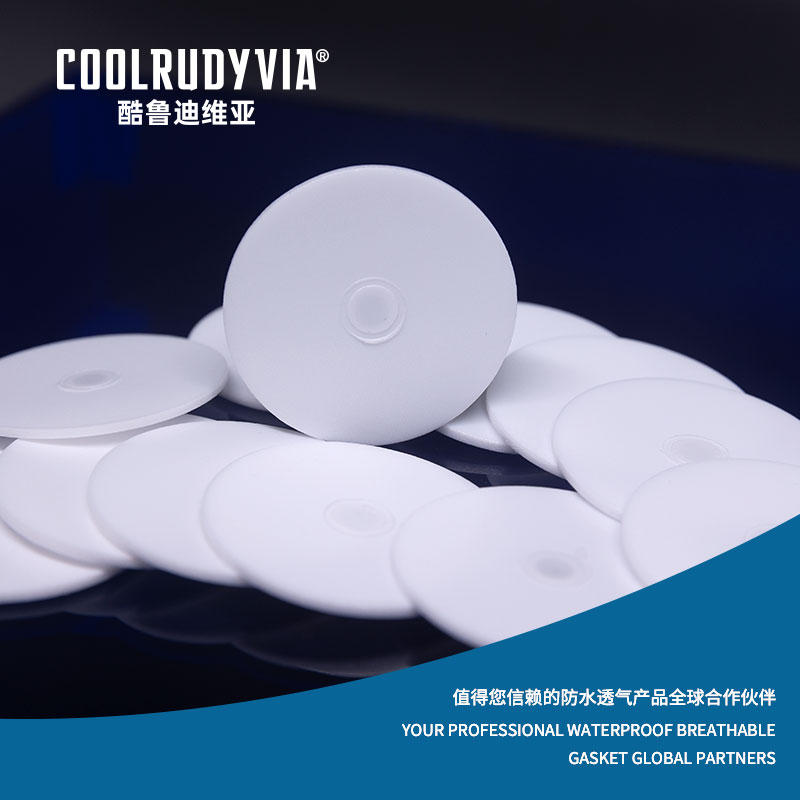 Waterproof Breathable PTFE Gasket for Pressure EqualizationA microporous PTFE membrane vent path prevents oversizing issues. This gasket balances air and vapor transfer while blocking liquid water, making it critical for rigid containers with worst-case pressure differentials.View Product →
Automotive and Outdoor Electronics: Higher Pressure, Higher Stakes
Automotive and outdoor electronics buyers specify breathable gaskets against ingress ratings and thermal cycling, not against airflow alone.
A headlamp assembly that cycles across that temperature band pushes and pulls air through the vent on every drive cycle. The membrane has to pass that volume while holding the ingress rating against road spray, washer fluid, and salt. A gasket that meets the airflow number but fails the water entry pressure test will fog, and fogging is a warranty claim rather than a line rejection.
For outdoor electronics, the housing material usually decides the format. Aluminum alloy vent plugs handle heat and mechanical abuse. Stainless steel vent plugs resist corrosion in coastal and chemical exposure. Plastic vent plugs keep weight and unit cost down on high-volume enclosures. The membrane inside is often the same, so the selection conversation is really about the mounting environment and the wall thickness it has to thread into.
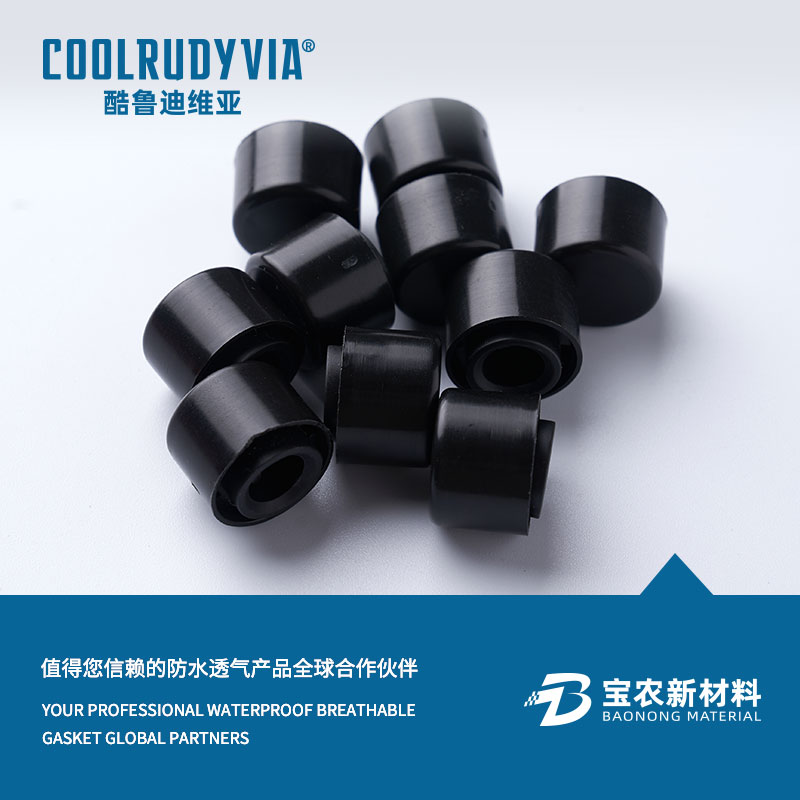 Adhesive-Backed ePTFE Vent Membrane for Automotive LampsSolves condensation in headlights and taillights by equalizing pressure through a microporous membrane. Easy to install and adaptable to various lamp housing designs, preventing moisture buildup.View Product →
Frequently Asked Questions
What is the difference between an aluminum foil gasket and an aluminum foil breathable gasket?
An aluminum foil gasket is an impermeable seal. An aluminum foil breathable gasket adds a microporous ePTFE membrane to the same laminate so the closure can pass air and vapor while still blocking liquid water. The aluminum barrier layer stays in both constructions. What changes is the vent path and the test data that supports it.
How much airflow does a breathable gasket actually need?
Size it from the worst-case pressure differential rather than from a default value. Take the maximum internal pressure rise across the storage and transport range, divide by the venting time the process tolerates, and pick the smallest membrane area that meets the result. Most packaging gaskets land between 20 and 300 milliliters per minute per square centimeter at 10 kPa.
Can a breathable foil gasket be induction sealed?
Yes. The aluminum layer that carries the induction current is also the moisture barrier, so a breathable gasket runs on standard induction equipment. The membrane has to sit outside the sealing ring footprint, and the adhesive coat weight sets the usable sealing window, commonly 2 to 5 seconds of dwell at the qualified power setting.
How should two breathable gasket suppliers be compared?
Compare five numbers: airflow range at a stated pressure, aged peel strength, water entry pressure, die-cut tolerance on the vent area, and membrane lot traceability. A quote that omits any of them is not comparable, because the missing measurement is usually where the price difference is hiding.

-
Phone Number
+86 138 6105 7907
-
Address
No. 58 Fengjiatou, Xiaoliu Village, Luoyang Town, Wujin District, Changzhou, Jiangsu, China
Copyright © Changzhou Baonong New Material Technology Co., Ltd.All rights reserved
PrivacyCustom Waterproof Breathable Membranes/Gaskets/Plugs/Caps